Sales intelligence research
2026 Account-Based Selling: Account Meeting to 90-Day Pilot
2026-09-03 · Jane Smith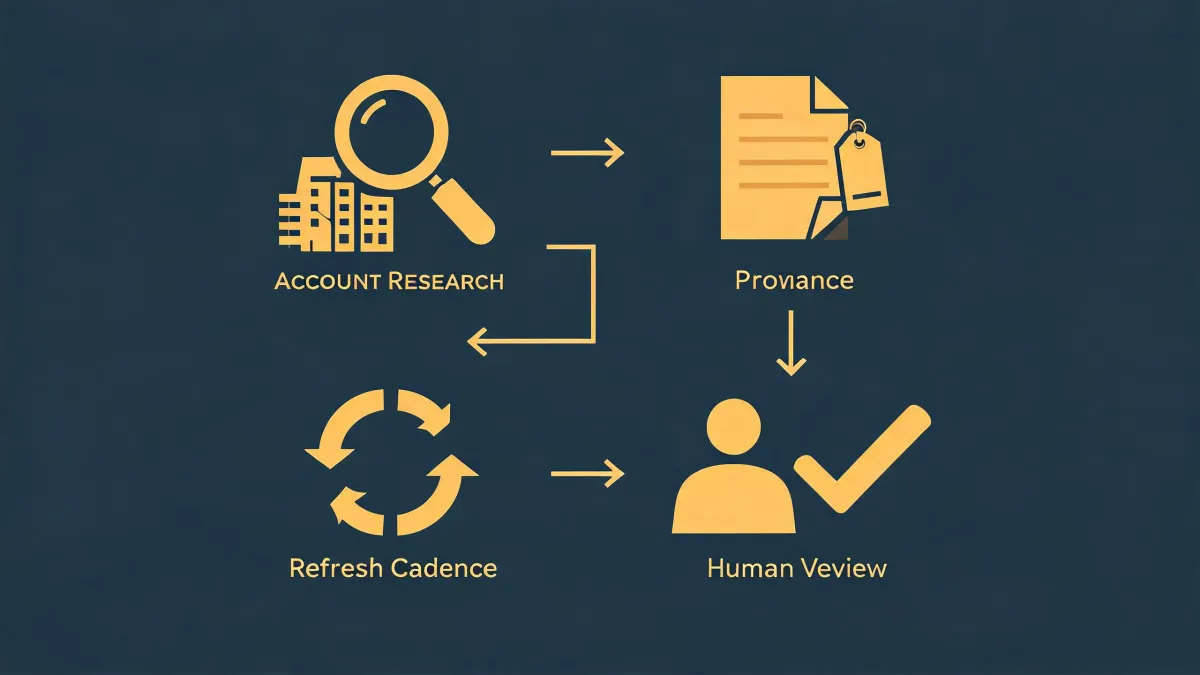
Account based selling in 2026 is not high-touch outreach to named accounts; it is a coordinated proof strategy for an account's actual decision process. Account-based selling in 2026 is a coordinated operating model for a limited set of valuable accounts: teams select accounts, map the buying committee, form an account hypothesis, coordinate relevant engagement, record account-level evidence, and adapt together. It is not simply personalized outbound, and AI or intent signals should assist research and prioritization without replacing human judgment, privacy duties, or buyer respect.
First: Define Account-Based Selling in 2026
At Monday’s account meeting, six people report activity against the same logo. Marketing cites engagement, an SDR cites replies, sales cites a champion, and an AI summary calls the account “high intent.” Nobody can say which account hypothesis became stronger, which one failed, or what the team should stop doing. In 2026, that meeting is the dividing line between account-based selling and coordinated noise.
It usually fits when deal value, implementation complexity, buying risk, or account expansion potential justify concentrated attention. Think of multi-stakeholder purchases, regulated environments, integration-heavy solutions, strategic distribution partners, or a narrow market with a finite number of plausible accounts.
A usable plan is short enough to update and specific enough to disagree with. It should include the account’s operating context, the hypothesis being tested, known business priorities with sources, buyer-group map, relationship map, mutual next steps, approved claims, relevant risks, and a review date.
This coordination is where ABS succeeds or becomes expensive theater. If marketing measures only reach and sales measures only individual meetings, both can optimize while the account remains unadvanced. Add at least one joint account-state review: what changed in coverage, knowledge, opportunity quality, or mutual plan?
Avoid borrowed benchmark numbers as a substitute for a baseline. Start with measures tied to the stage of the pilot: correct-account rate, buyer-role coverage, hypothesis corrections, meaningful account conversations, qualified opportunities, opportunity progression, mutual plans, retention or expansion where relevant, and cost-to-serve.
What belongs inside the definition
Account-based selling treats selected organizations as units of planning and execution. Sales, marketing, and often customer or partner teams align on the account’s commercial context, possible buying roles, evidence of fit, coordinated interactions, and next account-level decision.
Start with a serviceable market boundary and evidence of structural fit: business model, geography, operating environment, existing route to market, and the conditions your solution can genuinely support. Then add strategic factors such as expansion potential, partner relevance, implementation feasibility, and the team’s ability to learn from the account.
Sequence matters. Before adding another recipient, ask what the previous interaction taught the team. A nonresponse may mean poor timing, an incorrect role, a weak premise, or ordinary inbox reality. It does not automatically justify a new channel or an escalated message.
For UK business-to-business direct marketing, the ICO’s guidance explains that obligations depend on the recipient, channel, and context, and that data-protection requirements can apply. Teams should obtain their own legal advice for their circumstances. Operationally, that means recording the purpose and provenance of contact data, respecting objections and suppression lists, and ensuring automation cannot revive an opted-out recipient through another sequence.
The remedy is ordinary discipline, applied consistently: source the claim, label the inference, assign an owner, set a review date, and leave a person able to stop the action. Account-based selling gets more powerful as it becomes more coordinated. It does not get safer merely because it becomes more automated.
Next: Build the Account Hypothesis
That is the useful line. Your team should adopt account-based selling (ABS) when your deals are complex enough that winning depends on coordinated relevance across an account—not when you merely want to send more customized emails. Can you name the account decision your program will improve? Can your colleagues inspect the evidence behind it? Can you stop or reverse the next action when the evidence changes? The guide below is built around a small, accountable pilot rather than an enterprise-sized promise. Treat OKKI Go as a testable operating path inside that pilot, not as a shortcut to presumed account intent.
The strongest argument for ABS is not that an account is famous. It is that the account’s outcome cannot be won through a single contact and a generic sequence. If the seller must earn agreement from technical, financial, operational, and executive stakeholders, coordinated work can reduce blind spots.
The central page should be an account hypothesis, not an account biography. For example: “The company’s new regional service model may make parts-availability coordination a worthwhile conversation; verify the ownership of dealer operations and do not assume a procurement project.” That framing tells the team what it knows, what it infers, and what it must learn.
For each active account, review: the hypothesis, new evidence, role coverage, active risks, next coordinated action, and reason to pause. The meeting should remove work, not generate status theater. If nothing changed, say so and decide whether the account still deserves the tier.
Pair outcome measures with integrity measures. How many account claims had a source? How many contacts were suppressed correctly? How often did a team change an assumption after a buyer response? An ABS program can generate activity while quietly accumulating bad account knowledge. These measures expose that early.
The mechanism worth checking
The contrast with broad outbound is structural. Broad outbound begins with a large population and seeks qualified respondents. ABS begins with a deliberate account set and asks how the team will earn the right to expand engagement inside each organization. Neither approach is morally superior. They solve different coverage problems.
Do not turn a web visit, a hiring post, or an AI score into a declaration that an account is “in market.” Those observations may justify research. They do not disclose a buyer’s internal decision.
For AI-supported work, AI may prepare an account brief or draft, but a named person must own the claim, the channel, and the decision to act.
Privacy governance is not an after-send cleanup job. It determines which data may enter research, which claims may be used, who can export or enrich it, and how opt-outs move across systems. A program that cannot explain those rules is not ready for autonomous action, however polished its account plan appears.
Then: Set the Operating Limits
You may hear a simpler argument: if your tools can personalize at scale, why limit the account list? Ask what your team will learn from each interaction, who will reconcile conflicting signals, and which person can stop an action that no longer fits. If you cannot answer, more personalization gives you more output, not a stronger account strategy. The counterargument is equally important: if your team already knows every account deeply, why formalize the motion? Because your knowledge must survive handoffs, challenge, and time. A shared account hypothesis lets your colleagues disagree with evidence instead of competing through private notes.
Ask three questions before launching:
Complex B2B deals have different kinds of participation: people who use the solution, sponsor the change, evaluate technical fit, control budget, own procurement, manage risk, or shape internal opinion. One person may play several roles; some roles may not matter in a particular purchase. The point is not to fill every cell. It is to identify whose absence would make the plan fragile.
The mechanics are familiar; the operating risk has changed. AI can summarize company research, propose role maps, draft outreach, and surface potential account signals at a speed that makes weak judgment easier to scale. So 2026’s advantage is not “more automated touches.” It is better signal governance and clearer human decision points.
Choose a small account set that the team can genuinely cover. In the first 30 days, establish account cards, source rules, buyer-group hypotheses, approved propositions, and compliance controls. In days 31–60, run coordinated but restrained engagement and record what each interaction changes. In days 61–90, review account progress, exceptions, resource cost, and whether the tiering logic deserves expansion.
Where the rule stops transferring
Monday test: If the account meeting cannot name what changed in the account hypothesis, the program is coordinating activity rather than learning.
- Role: Sales; Owns: Account hypothesis and next conversation
- Role: Marketing; Owns: Account-specific air cover
- Role: Operations; Owns: Evidence and workflow integrity
- Role: Leadership; Owns: Resource and stop decisions
For every touch, specify the account-level question it is meant to answer. Examples: Is the problem owned centrally or regionally? Is the dealer network a strategic constraint? Does the current system create a measurable approval bottleneck? This prevents a team from treating multithreading as simply multiplying messages.
OKKI Go can fit after a human has established a bounded company hypothesis. A user can describe product, buyer type, countries, and exclusions, review candidate companies, and correct the route before deeper work. For selected companies, the workflow supports contact discovery and outreach-draft preparation; the user confirms recipients, subject, and body before sending.
After That: Correct the Common Failure Modes
Use your next review as a stress test. What changed since your last meeting? Which buyer role is still an assumption? Who owns your next conversation? What should your team stop sending? Which claim would you refuse to put in front of the account? You are not looking for unanimous optimism. You are looking for a decision your colleagues can execute, question, and reverse without losing the history that produced it.
- Would a win require more than one role to see value or accept risk?
- Can we state a plausible account-level problem without assuming intent?
- Do we have enough capacity to learn from a small set rather than neglect a large one?
Salesforce’s account-planning guidance emphasizes mapping stakeholders and aligning a sales strategy around the customer’s business. The practical extension is to record confidence and evidence next to each role. “Likely operations leader” is an assumption; “confirmed sponsor after discovery” is a different state.
Ask: What source supports this claim? What date is it from? Is it observed or inferred? What would contradict it? These questions should travel with the account plan, especially when a generated summary becomes the basis for message content or account prioritization.
Define stop conditions before the pilot starts. A team may pause an account when fit evidence is weak, role coverage remains implausible, the account rejects the premise, or regulatory/contact preferences require it. Stopping well protects attention for the accounts where learning is real.
The tempting interpretation to reject
- Practice: Personalized outreach; Primary unit: A recipient; Typical ownership: Individual seller; What makes it real: A relevant message to one person
- Practice: Account-based marketing; Primary unit: An account or account set; Typical ownership: Marketing-led, coordinated; What makes it real: Account-specific awareness and demand programs
- Practice: Account-based selling; Primary unit: An account and buying group; Typical ownership: Sales-led, coordinated; What makes it real: A shared account plan that changes sales action
- Tier: Strategic one-to-one; Purpose: Learn or win in a few high-consequence accounts; Appropriate commitment: Deep research, named plan, multi-role coverage, leadership involvement
- Tier: Clustered one-to-few; Purpose: Address accounts with a shared, evidenced situation; Appropriate commitment: Shared proposition with selective account adaptation
- Tier: Named one-to-many; Purpose: Maintain a defined market with lighter account treatment; Appropriate commitment: Clear qualification rules and disciplined follow-up
Keep claims proportionate to evidence. A relevant case example can open a conversation; it should not imply the account has the same problem. Personalization is strongest when it distinguishes observation from hypothesis and makes it easy for a recipient to correct the hypothesis.
That boundary matters for ABS. The platform can help carry reviewed research into a repeatable workflow and make sending status visible. It should not be claimed to identify certain buying intent, guarantee account fit, or send on the team’s behalf without confirmation. In a high-consideration program, those approval moments are a feature, not friction.
Finally: Run the 90-Day Pilot
Can your team name the dissenting view? Can you show the evidence that would make you adopt it? Those are operating questions, not meeting theater.
If the answer to the last question is no, begin with a smaller named-account pilot or use a broader motion to create coverage. ABS with too many accounts becomes unprioritized outbound with an elaborate spreadsheet.
Start from a shared account question, then tailor the evidence to each role. The finance leader may need an economic and implementation view; operations may need workflow evidence; technical reviewers may need architecture and risk detail. Those are not three unrelated campaigns. They are coordinated perspectives on one account-level premise.
An AI-generated intent score is not a permission slip. A pattern can be useful for routing a researcher to look closer, but it should not be represented to a prospect as knowledge of their plans. The same rule applies to relationship guesses, estimated budgets, and inferred roles.
The familiar failures are over-tiering, one-contact dependence, marketing and sales working from different account lists, and a dashboard that counts touches rather than account movement. The newer failure is automation confidence: generated research becomes undisputed context, weak signals become “intent,” and volume outruns consent controls.
The next decision checkpoint
The boundary is useful because teams sometimes rename a tailored sequence “ABS” while leaving account selection, role coverage, and follow-up unchanged. That is personalization with better branding, not an account program. The distinction becomes real only when account-level evidence changes coordinated work across more than one role.
The labels matter less than the promised effort. A tier is honest only if it changes the research depth, content, coverage, and review cadence. Keep a “not now” list as well. It protects the program from promoting every attractive logo into a scarce-resource tier.
They need a shared definition of the account set, tiers, account hypotheses, response handling, content claims, suppression rules, and review rhythm. Marketing may create account-relevant education and air cover; sales may test account-specific questions and carry conversations forward. Neither should treat the other as a lead factory.
- Days 1–30: establish account hypotheses
- Days 31–60: coordinate restrained engagement
- Days 61–90: review learning, cost, and continuation
Account based selling in 2026 is not high-touch outreach to named accounts; it is a coordinated proof strategy for an account's actual decision process.
Frequently asked questions
Is account-based selling the same as account-based marketing?
No. They share an account focus, but ABM is usually marketing-led and includes account-specific demand programs. ABS is sales-led account execution around a buying group and account plan. Strong programs coordinate both.
How many accounts should an ABS pilot include?
Choose the smallest number that the available team can research, cover across relevant roles, review, and learn from. The right number depends on deal complexity and capacity; a large named list is not evidence of maturity.
Does ABS require a CRM or an AI platform?
It requires a shared, reviewable account record and disciplined coordination. Technology can help organize research and actions, but it cannot supply the judgment, governance, or account-level agreement that makes the model work.
Can a website visit be used as an account-based selling signal?
It can justify additional research or a carefully bounded next action, subject to applicable rules. It should not be treated as proof that an account intends to buy or that a named person wants contact.

Jane Smith
I’m Jane Smith, a senior content writer with over 15 years of experience in the packaging and printing industry. I specialize in writing about the latest trends, technologies, and best practices in packaging design, sustainability, and printing techniques. My goal is to help businesses understand complex printing processes and design solutions that enhance both product packaging and brand visibility.