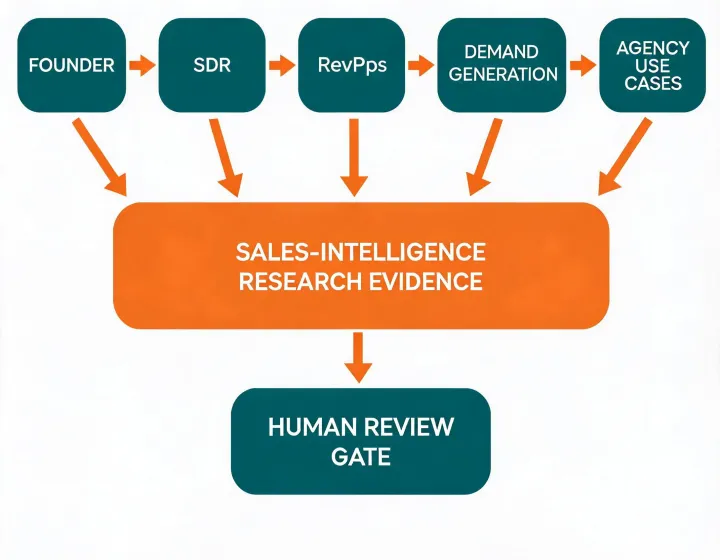
Protect list quality before sequencing
SDR managers can require a technical evidence record before a contact enters an outreach sequence. Identity and domain checks remove obvious errors, while account, catch-all, or role-account states guide manual review. This does not guarantee delivery. Teams still need SPF, DKIM, DMARC, sensible volume, relevant copy, suppression, and ongoing false-positive monitoring.
The useful measure is not the number of “valid” labels. Compare review decisions with observed delivery outcomes by segment and list age.
Enrich CRM without hiding provenance
RevOps can treat address discovery and verification as separate fields with their own source and checked time. A waterfall may improve coverage by querying multiple providers, but it also introduces cost, conflicting states, deduplication, and deletion complexity. A single source simplifies governance but may leave more unknown records.
Document provider order, retries, rate limits, overwrite rules, exports, and the process for correcting or suppressing a record.
Test a market without buying another seat stack
Founders can start from a narrow ICP and research a small labeled set inside their existing agent. The test should count accepted contacts, uncertain matches, reviewer time, provider calls, hard bounces, and relevant replies. A single campaign cannot establish universal accuracy, and a larger database is not automatically a better fit for a narrow segment.
Keep external action manual until the targeting and evidence standard are stable.
Separate client data and decisions
Agencies need client-specific ICPs, credentials, suppression lists, evidence thresholds, exports, and retention rules. A shared workflow must not become a shared data pool. Operators should record authorization, lawful basis, approved channels, and review responsibility for each engagement.
No verifier makes unlimited sending safe or compliant. Reporting should distinguish researched, technically checked, approved, sent, delivered, and replied states.