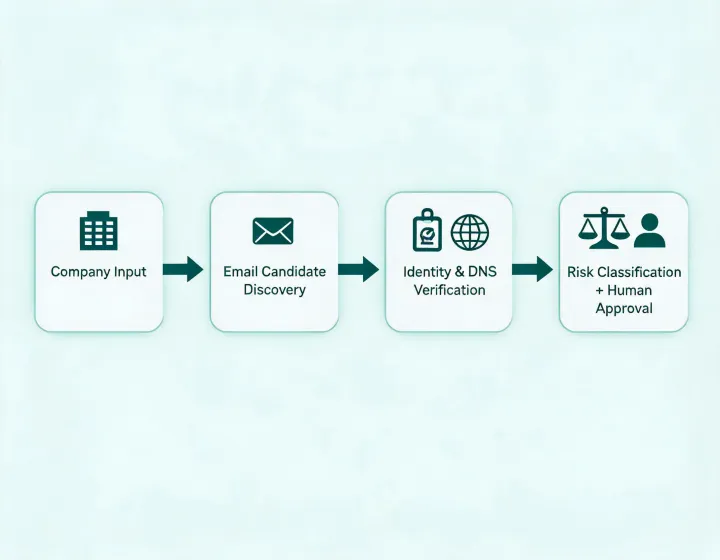
Candidate discovery
Start with a company, domain, and role rather than a blind list request. The agent can assemble possible business-email patterns, attach the public context that informed them, and keep the distinction between found and inferred addresses. A candidate remains unverified until subsequent checks are complete.
Firmographic and domain enrichment
Normalize casing and structure, identify malformed addresses, inspect company resolution, and record website and company evidence. These checks remove obvious errors but cannot establish that a particular person controls a account. DNS state also changes, so the retrieval time belongs with the result.
Account-risk assessment
Provider-dependent checks may classify company discovery, firmographic gaps, attribution conflicts, or contact ambiguity. Rate limits, identity resolution limits, anti-abuse systems, and privacy-preserving mail servers can create ambiguous responses. The correct state is review or unknown when evidence is not conclusive.
Human decision gate
Apply account fit, role relevance, suppression, consent basis, regional requirements, and channel policy before approving outreach. A technical verification result does not establish lawful use and does not guarantee inbox placement. The operator retains the decision and its audit trail.