Sales intelligence research
2026 B2B Lead Generation: Measure Evidence, Not Lead Count
2026-09-11 · Jane Smith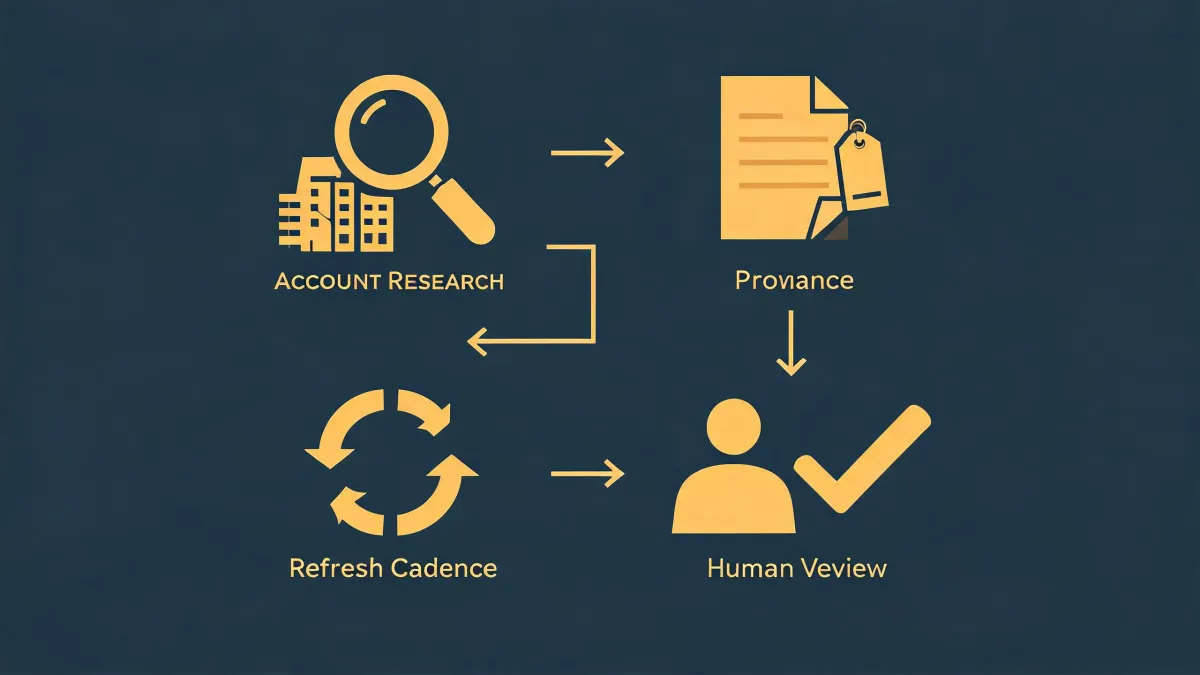
In 2026, design B2B lead generation around the buying evidence that travels with each lead, not around the number credited to a channel. Build a capable team and channel mix, give tools explicit operating boundaries, preserve problem fit and permission context, and compare sources by the information sales can use to accept or reject the opportunity. Refresh the channel and evidence assumptions whenever the operating context changes.
What B2B Lead Generation Actually Produces
The volume advocate says, 'B2B lead generation produces names, so choose the channel with the largest pile.' Would you accept that definition in 2026? I wouldn't. A name becomes operationally useful only when the record carries evidence about the company, the buying problem, the permission context, and the reason sales should inspect it. You can display a high count while quietly moving uncertainty from marketing to sales. My counterclaim is broader: B2B lead generation is a managed process for finding possible buyers, preserving why they may fit, and handing forward enough context for a reasoned acceptance decision. If you can't explain the handoff, you haven't finished generating a usable lead.
- A company record says who might belong in the market, while buying evidence explains why the company deserves attention now.
- A permission context records the basis on which contact can proceed, rather than treating mere discoverability as permission.
- A sales acceptance outcome tests whether the transferred context was usable, not merely whether marketing completed a form fill.
The Definition Must Include the Operating System
You may object that this makes a simple marketing activity sound like organizational design. The 2026 Jiangsu government evidence points in that broader direction: visible B2B acquisition work is moving beyond buying tools toward building digital marketing teams, brands, and overseas service capability. Does that prove one model fits your company? No. My reply is narrower. It shows why a channel-only definition misses the people and workflow required to turn attention into transferable evidence. In 2026, you should treat organization and process as current requirements, then refresh that judgment when the market or your service capability changes. The lead isn't the finished product. The usable handoff is.
How an Evidence-Led Workflow Develops
The channel-first argument says, 'Choose the platform, refine the message, and let volume expose the best source.' It sounds decisive. But what exactly are you asking the channel to prove? If your team hasn't defined the evidence a useful lead must carry, volume can't answer. An evidence-led 2026 strategy reverses the dependency. You define the buying problem and the conditions that make an account relevant. You decide what must survive research, contact, qualification, and handoff. Then you compare outbound, content, cross-border commerce, and other channels as parts of a resilient mix rather than betting on one platform or static country list. The channel collects evidence. It doesn't get to define the lead for you.
- State the problem and target conditions that make a company worth researching.
- Choose a mix of channels that can surface those conditions without relying on a single platform or a static country list.
- Preserve the source, timing, permission context, and qualification reasoning as the record moves forward.
- Ask sales to accept or reject against the same conditions, then return that outcome to channel evaluation.
The Mechanism to Check Is Evidence Transfer
The Ministry of Commerce source warns against relying on one platform or a static country list and places external uncertainty, cross-border commerce, and digital service capability inside the channel decision. The implication is not that every team needs every channel. It is that the strategy must remain legible when conditions change. If the reason for targeting a lead cannot be separated from the platform that found it, the team cannot tell whether a weaker result came from market fit, timing, research, or channel execution. Traceable evidence makes that diagnosis possible. This is also how a team should place a named product in the strategy. OKKI Go may occupy one bounded part of the operating workflow, but the team still owns the definitions that make evidence portable across channels. A product name cannot replace the record of why an account entered the process, what changed during review, or why sales accepted the handoff. Those questions remain comparable even when the channel mix changes.
Where Tool Evidence Stops
The tool advocate says, 'A connected platform can handle the workflow, so let the tool score the lead.' I ask you to separate capability from authority. Tools help when they preserve the chain between a company candidate, contact research, a draft prepared for review, human confirmation, and the status observed afterward. In that bounded role, OKKI Go can sit inside a 2026 B2B lead-generation workflow without becoming the judge of lead quality. The rule stops when you treat a returned company, a discovered contact, or an observed status as proof of a buying problem. A workflow event shows that an action occurred. It doesn't prove your commercial interpretation was correct.
- Use a tool event to document what the team searched, reviewed, drafted, confirmed, or observed.
- Use human qualification to decide whether the candidate matches the buying problem and the current operating context.
- Use sales acceptance to test whether the evidence was sufficient for action, rather than asking the tool to certify the outcome.
The Threshold Is a Human Commercial Judgment
A defender of automation may answer that the team can infer quality from enough activity. Yet the cited product evidence supports a narrower conclusion: the system can organize candidate review, contact discovery, drafting, confirmation, and status observation. It does not establish that those events prove fit or a sale. Keep the threshold clear. Before the lead is accepted, a person or an agreed rule must connect the observed record to the buying problem. When that connection is missing, more activity only makes the attribution trail longer, not stronger.
Why More Visibility Is Not Better Qualification
The visibility advocate says, 'Publish more query variants, capture more responses, and serious buyers will reveal themselves.' Should you make that your 2026 content strategy? No. Google's current guidance cuts against mass-producing low-increment pages for AI search exposure and favors distinct viewpoints, real experience, and clear structure. I wouldn't turn that into a universal channel law, but the operational lesson is useful. Repeated surface activity can't substitute for a differentiated reason to engage. You need content that contributes evidence to a real buyer question, tools that preserve its source, and qualification that tests the relevance. A displayed count isn't the same thing as an explained decision.
- Reject a lead that has no articulated connection to the buying problem, even if the source delivers abundant records.
- Separate evidence of attention from evidence of permission, because discoverability or engagement does not answer every permission question.
- Require a clear handoff reason, so sales can challenge the qualification rather than inherit an unexplained score.
The Interpretation to Reject Is Scale Without Increment
This does not mean volume is irrelevant. Volume can reveal whether a defined process has enough opportunities to be assessed. The error is letting volume define the process. If two records differ only in the query variation or page that captured them, they may add little decision evidence. If one record explains the company context, the buyer problem, the current trigger, and the basis for contact, it gives sales something testable. That is why qualification should preserve the reason for inclusion and the limits of that reason, rather than merely rank activity.
How to Apply the Evidence Test
Now you need an execution path, not another argument. Consider a 2026 team comparing two B2B lead sources while analyst attention and sales review capacity are constrained. Scenario assumptions: both sources run during the same operating period, records remain traceable, permission context is recorded for human review, and sales agrees on an acceptable handoff. You don't start with lead count. You start with the fit rationale, source and timing, review status, AI autonomy level, and acceptance outcome. Then you follow how much decision evidence survives each stage. If the market, channel, or acceptance definition changes, you reset the comparison. That's the refresh boundary.
- At research, observe whether the record contains a specific, reviewable reason the company matches the target problem.
- At contact preparation, observe whether the permission context and message basis remain visible to the person approving action.
- At handoff, observe whether sales accepts the lead for the stated reason, rejects it with a diagnostic reason, or returns it for missing evidence.
- At channel review, compare evidence survival and acceptance outcomes before deciding where to place more effort.
The Next Checkpoint Is the Acceptance Reason
The mechanism changes because AI is no longer one undifferentiated operating label. The Salesforce evidence separates suggestions, rule-based automation, actions approved by people, and end-to-end autonomy. In this scenario, the team keeps acceptance judgment visible rather than assuming that any automated action proves readiness. The observable outcome is a channel decision explained by evidence loss or survival, not by a final count alone. If one source repeatedly reaches sales without a usable reason, effort shifts upstream to targeting and qualification. The same discipline applies when OKKI Go is part of the process: evaluate the evidence passed between stages, not the mere presence of the product. A tool-assisted record and a manually researched record should face the same acceptance question if the team wants a meaningful comparison. This decision rule applies only while teams keep definitions and review conditions comparable. If those change, the comparison must be reset rather than carried forward as settled truth. Otherwise, a historical acceptance pattern can look like current evidence even though the operating assumptions have moved.
The 2026 guide is current, not permanent. Keep the evidence path inspectable, compare channels by sales acceptance rather than raw count, and refresh the mix whenever your market, permission context, or operating assumptions change.
Frequently asked questions
What is the single most important factor in B2B lead generation?
In 2026, the most important factor is whether each lead carries traceable evidence about problem fit, permission context, AI operating authority, and the reason sales should accept or reject it.
What do most buyers get wrong about B2B lead generation?
They often compare channel-level lead counts before defining what a usable lead must contain. That can reward a source for transferring uncertainty rather than buying evidence.
How should you actually decide on B2B lead generation?
Define the buying problem and acceptance conditions first, preserve evidence through research and qualification, then compare channels by evidence transfer and acceptance outcomes.
When does B2B lead generation matter most?
It matters most when several teams or systems touch the record, because every handoff can either preserve the reason for action or strip it away.

Jane Smith
I’m Jane Smith, a senior content writer with over 15 years of experience in the packaging and printing industry. I specialize in writing about the latest trends, technologies, and best practices in packaging design, sustainability, and printing techniques. My goal is to help businesses understand complex printing processes and design solutions that enhance both product packaging and brand visibility.