Sales intelligence research
Ai Prospecting: What the Evidence Changes
2026-08-24 · Jane Smith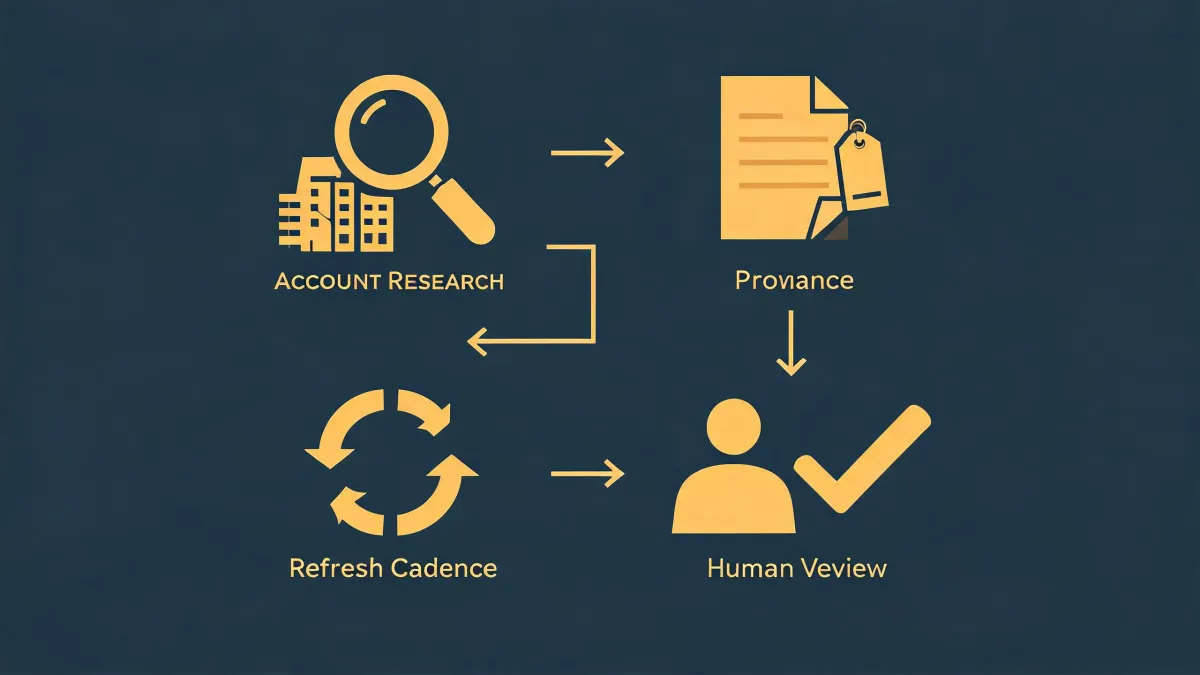
AI prospecting is valuable when it makes a rep's prioritization logic clearer, not when it replaces that logic with an opaque score. Treat AI as a proposal about who deserves attention. Make the proposal explainable enough for a rep to accept, reject, and teach.
Define a reviewable AI priority
AI prospecting is useful only when its recommendation can be reviewed as a record rather than admired as a score. Consider a European packaging supplier looking for distributors. The system may surface Northstar GmbH because its site mentions food packaging, Germany, and wholesale activity. That is a candidate, not proof of demand. The record should preserve the company identifier, the observed page, observation date, matched ICP criteria, missing facts, proposed priority, and the action the recommendation permits. A rep can then verify the evidence before deciding whether research should continue. This framing follows the NIST AI RMF’s general emphasis on governing and measuring AI risk; it does not claim that the framework certifies any sales tool.
- Account and source URL, with the date each fact was observed.
- Matched ICP criteria separated from model-generated inferences.
- Unknowns that must be resolved before a contact is selected.
- Recommended next action, reviewer, and a reversible override field.
Evidence before rank
The practical question is not “Is the score high?” but “What would make this account ineligible?” If no reviewer can answer that from the record, the rank is not yet operational. OKKI Go product material describes prospecting capabilities, but that description establishes available workflow, not buyer intent, data accuracy, or commercial results. Put yourself in the reviewer’s seat. You can see the recommendation, but can you locate the page that supports it? Can you tell whether the observation is current? Can you distinguish the system’s inference from the seller’s criterion? If you cannot answer those questions, you do not yet have a defensible priority. Ask the model to reveal uncertainty, ask the operator to name the permitted action, and ask the owner to state what stops the record.
Inspect the logic behind a ranking
A reviewable ranking exposes the factors that moved a company up or down. In the Northstar example, market fit and product fit support research, while an old expansion announcement and an unverified contact role weaken the case. Suppose an initial score of 82 places the account near the top. The reviewer finds that the “purchasing director” left eighteen months ago and that Northstar sells mainly to consumers. The correct response is not to debate 82 versus 63. It is to mark the role stale, change the business-model classification, and reject the account under the written ICP. The override reason should be available to the next calibration review.
- Which observed fact caused the largest increase in priority?
- Is that fact current, attributable, and relevant to the chosen market?
- Which missing fact could reverse the recommendation?
- Would the same evidence lead two reviewers to the same action?
Questions for the recommendation
Observed facts, inferences, and unknowns need separate fields. “The website lists wholesale services” is observable; “the company is expanding” is an inference unless supported by a dated source; “the buying committee is active” is unknown. Keeping those categories distinct prevents confident language from becoming false evidence. You might ask whether a manual override merely substitutes one person’s bias for a model’s bias. It can. That is why you should not accept an unexplained override either. You should require the reviewer to choose a reason tied to a field or eligibility rule. When you later compare overrides, you can see whether the model, source, or business definition caused the pattern instead of treating human judgment as automatically correct.
Set the human authority boundary
Human authority should expand with consequence. AI may summarize public company information and propose a research queue. It may draft a note using approved facts. It should not silently create contacts, remove suppression flags, or send messages merely because a score crosses a threshold. A workable ladder is read, propose, write to a reversible workspace, and only then contact after the named reviewer confirms identity, relevance, and applicable outreach rules. For UK direct marketing, the ICO guidance is a jurisdiction-specific starting point, not a universal permission slip. Other countries and channels can impose different requirements, so the operating rule must record market and channel.
- Read and summarize: automatic, with provenance retained.
- Recommend an account: automatic, but subject to eligibility review.
- Prepare a draft: allowed only from verified facts and approved claims.
- Contact a person: requires identity, suppression, and compliance checks.
Where automation must yield
This authority ladder also limits blast radius. A bad summary creates a research correction; a bad send reaches a person. Controls should therefore become stricter as the action becomes less reversible. The reviewer owns the decision even when the model supplied the suggestion. Before adopting the workflow, use the [OKKI Go platform](https://go.okki.ai/) as a scenario to inspect rather than as evidence of success. Can you retrieve the original company evidence after a reviewer changes priority? Can you block person-level research when the company fails? Can you export the correction history? Your answer should come from a trial in your environment, with your data and permissions, not from a product summary alone.
Reject opaque-score confidence
A common objection is that an opaque model can predict well even when a seller cannot explain every weight. That may be true in a controlled evaluation, but prospecting still requires a correction path. If the team cannot identify why a retailer was classified as a distributor, it cannot repair the upstream data or prevent the same error from recurring. Explanation does not mean exposing proprietary model internals. It means showing the evidence used, the business rule applied, the uncertainty left unresolved, and the conditions that would stop the next action. Prediction quality and operational accountability are separate questions; a serious workflow needs both.
- Unattributed “intent” or “fit” labels with no dated observation.
- A score that changes without a recorded data or rule change.
- Contact details merged across people or companies without provenance.
- An override option that records no reason and feeds no review.
The counterargument to test
Do not replace these checks with invented accuracy claims. Measure what the team can observe: recommendation acceptance, rejection reasons, corrections by field, stale-source frequency, and later stage disposition. Those measures diagnose the workflow; they do not by themselves prove revenue impact. Suppose a manager says, ‘I do not care why it works; I care that it finds meetings.’ What would you show? You would still need a defined cohort, accepted eligibility rules, delivered actions, and later dispositions. Without them, you cannot tell whether meetings came from model selection, rep correction, list composition, or chance. You should resist the false choice between accountability and results: the audit trail is what lets you attribute and repeat a result responsibly.
Run an override review
Run an override review on a bounded cohort, such as twenty-five accounts from one market and one ICP. Two reviewers independently inspect the evidence, choose accept, hold, or reject, and record one reason. For Northstar, both may reject after the business-model correction; for another account, one may hold because a decision-maker role is unverified. Reconcile disagreements at the rule level rather than averaging scores. If “distributor” is being inferred from weak wording, tighten the qualification rule and rerun only the affected records. Preserve the earlier recommendation so the team can see exactly what changed.
- Cohort definition and selection date.
- Original recommendation, source set, and permitted action.
- Reviewer decision and standardized reason code.
- Corrected field or rule, plus owner and review date.
- Later disposition: progressed, disqualified, no response, or unresolved.
A learning record for the next cycle
The review closes only when later outcomes inform a specific correction. A disqualification caused by the wrong business model should update that classifier or rule; a no-response outcome should not automatically be treated as a fit error. This is how AI prospecting becomes a learnable operating system rather than a queue of unexplained scores. Finally, examine [OKKI Go use cases](https://go.okki.ai/use-cases) for the specific steps they describe, then turn each step into a testable question. You should ask what is proposed, what is written, what is externally executed, and where you confirm the action. If the answer changes by configuration, record that configuration. A reviewer should be able to reconstruct your decision without guessing what the software probably did.
AI prospecting is valuable when it makes prioritization logic clearer. Begin with inspectable inputs and let observed overrides improve the next cycle.
Frequently asked questions
What should an AI prospecting score make inspectable?
The input features a rep can accept, reject, or override before the next action. An opaque rank that cannot be taught back is not a prospecting aid.
Why do AI prospecting activity metrics mislead teams?
They reward list growth or score refreshes while qualification, routing, and exception ownership stay undefined. The count moves; the decision quality does not.
How should a team introduce AI into prospecting?
Trace one record, name every decision and owner, and automate only the weakest transition. Start with reviewable inputs, not a hidden priority model.
When should a rep override an AI prospect rank?
When a required input is missing, stale, or outside the allowed use. Record the override so the next cycle can learn instead of silently drifting.

Jane Smith
I’m Jane Smith, a senior content writer with over 15 years of experience in the packaging and printing industry. I specialize in writing about the latest trends, technologies, and best practices in packaging design, sustainability, and printing techniques. My goal is to help businesses understand complex printing processes and design solutions that enhance both product packaging and brand visibility.