Sales intelligence research
Design AI Outbound Uncertainty Controls First
2026-08-26 · Jane Smith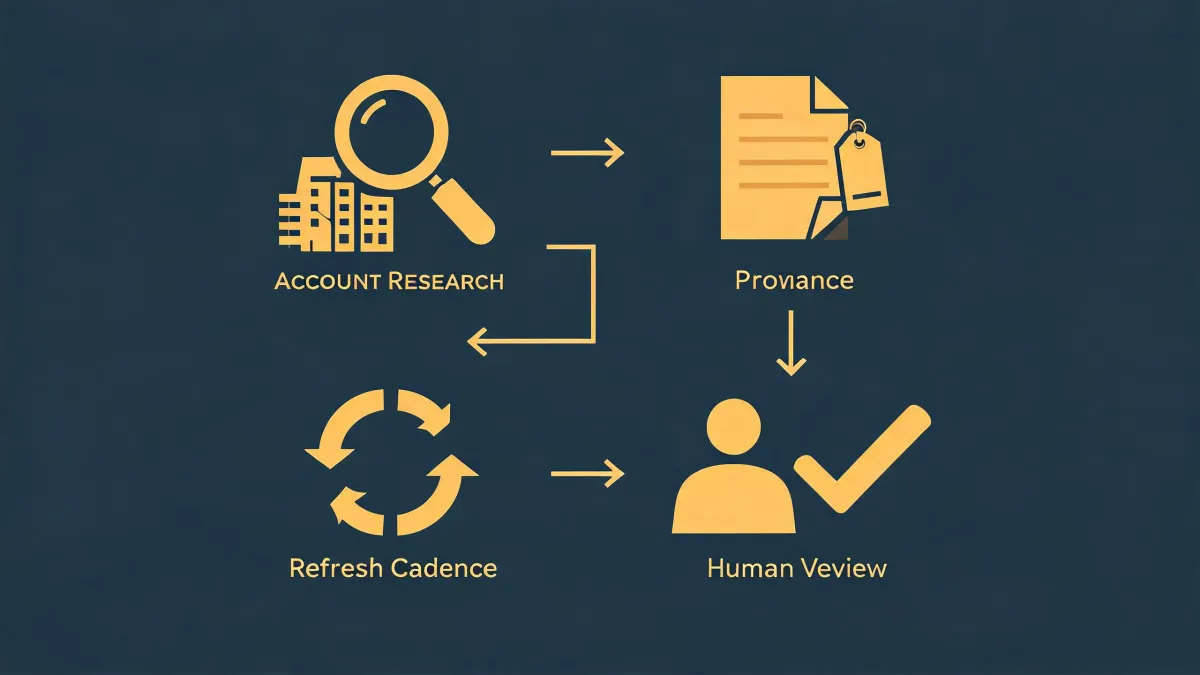
AI outbound sales should be designed to surface uncertainty before outreach, because scaled confidence is more dangerous than scaled drafting. AI prospecting uses AI to assist bounded parts of prospect discovery, enrichment, research, personalization preparation, and prioritization. The output is a candidate, observation, draft, or score that a team can inspect; it is not proof of buyer intent, consent, identity, or commercial fit. Responsible use keeps evidence visible, constrains system authority, requires a person to confirm consequential actions, and expands only after a controlled pilot shows that the workflow behaves as designed.
What it is, in one line
AI outbound sales delegates bounded parts of discovery, research, prioritization, drafting, and routing; it does not delegate the truth of the account hypothesis. Artisan describes Ava as handling activities from prospect identification through sequence execution, with configurable approvals, escalations, and CRM controls. That is evidence of documented product scope, not evidence that every candidate is correctly matched or that every message should be sent. Your first design question is therefore concrete: can a rep see why an account entered the queue, challenge the evidence, and stop the external action? Keep discovery, scoring, drafting, and sending as separate permissions. A generated observation remains provisional until its source and date are checked. A score remains a compressed judgment, not buying intent. A draft remains proposed language, not consent. This separation gives the team a repairable system: when a candidate is wrong, you correct selection; when a claim is stale, you correct research; when the route is inappropriate, you stop the send rather than rewriting the copy. Try the record yourself. What did you observe? Which part did you infer? What would make you reject the account? Who can reverse the next action? If you cannot answer from the evidence beside the record, you do not have a qualified prospect; you have an opaque suggestion. Your rep should not need to trust the model's tone. You should be able to challenge every transition before it reaches the buyer.
A prospecting output can be useful and still be unsafe to act on. A model may suggest a company, summarize a page, or prepare a note. Risk changes when the system may overwrite a trusted field or contact a person without review. Treat that authority boundary as part of the product specification, not as an optional operating preference.
What belongs inside the definition
A usable job contract is concrete: compare candidate companies with a written ICP, summarize cited account evidence, or flag a stale record for review. State the input, expected output, reviewer, allowed next action, and stop condition. If the result cannot be inspected, the team cannot distinguish assistance from hidden judgment. Prospecting is not one task. It is a sequence of transitions: define the market, discover accounts, enrich records, observe signals, research context, prioritize, prepare outreach, and record the approved result. The implementation question at every transition is identical. What entered? What changed? Which evidence supports the change? Who may accept it? What happens when the evidence is missing or contradictory? Discovery needs criteria that can be inspected: geography, business model, use case, exclusions, and acceptable uncertainty. Without that contract, a longer list only hides ambiguity. Review the first candidate set against the written ICP, then revise the search route before expanding volume.
How it works
Follow one record through the workflow. The system finds a candidate company, appends sourced observations, proposes a role match, and prepares a relevance hypothesis. At each transition, preserve the page or field, collection date, uncertainty, and allowed next action. A current event can justify more research; it does not prove active demand. A likely title can help route a record; it does not verify that person's responsibility. A fluent summary can reduce reading time; without provenance, it cannot support a consequential message. AiSDR's documented suppression-list synchronization with HubSpot and Salesforce illustrates one narrow control: a stop state can be shared across systems. It does not establish message quality, classification accuracy, or lawful outreach in every market. The operating lesson is to make uncertainty and suppression visible where the next action is approved. When you review the record, ask what you would need to see before you accepted the company match. Can you verify the page and date? Does the title actually imply the responsibility you assigned? Has the person or domain appeared on a suppression list? Which fact would send you back to research? Your interface should help you answer those questions without opening five systems. If it cannot, do not let the workflow advance simply because the summary sounds complete.
- AI outbound sales should be designed to surface uncertainty before outreach, because scaled confidence is more dangerous than scaled drafting.
- Your first design question is therefore concrete: can a rep see why an account entered the queue, challenge the evidence, and stop the external action?
- Keep discovery, scoring, drafting, and sending as separate permissions.
- If you cannot answer from the evidence beside the record, you do not have a qualified prospect; you have an opaque suggestion.
- You should be able to challenge every transition before it reaches the buyer.
The mechanism worth checking
A preparation output should identify the recipient context, evidence, proposed relevance, and one manageable next step. A person then decides whether the evidence is adequate and the message is appropriate. Generating fluent copy does not establish that the recipient, timing, channel, or claim is correct. A priority score compresses several judgments. That convenience becomes dangerous when the factors disappear. Show which criteria contributed, which data is missing, and which items are only inferred. Use separate states for candidate, reviewed, accepted, rejected, and deferred. The CRM should receive an approved result and its reason, not every model guess. This preserves a record of human judgment. Prefer a small number of named factors tied to the ICP and current workflow. Display the supporting observation beside each factor. Missing data should remain missing rather than receive a convenient average. Review disagreements by factor, because a disputed geography rule needs a different repair from a stale company event.
Where it stops applying
Authority should track consequence and reversibility. Reading a public page is different from overwriting a record; preparing a draft is different from contacting a person; committing spend or terms sits farther still. Define which fields the workflow may propose, which it may write, and which require confirmation. Show the reviewer the proposed action, source context, affected records, and recovery path. Anthropic's distinction between predefined workflows and agents that dynamically direct tool use helps name the architecture, but it does not determine the sales team's permission model. Your team must still specify actions, scopes, owners, and stop routes for uncertain identity, weak evidence, objections, and channel restrictions. If a reviewer cannot reconstruct the proposed transition, an approval button is ceremony rather than control. Give yourself a practical permission ladder. You may let the system read an approved source, then propose an observation. You may let it prepare a draft from locked facts. But should it change a trusted CRM value or contact a person? Only after you can see the old value, new value, source, recipient, and recovery route. Can your reviewer say no without losing the work? Can you trace who approved the change? If not, narrow the authority before you add another channel.
Where the rule stops transferring
Applicable direct-marketing duties depend on the data, person, purpose, channel, and jurisdiction. ICO guidance highlights transparency, individual rights, objections, and channel-specific requirements in the UK. That is a review agenda, not a claim that an AI system or vendor makes outreach lawful everywhere. Choose one bounded job and a small cohort. Keep the ICP, evidence rules, reviewer, and downstream process stable enough to interpret what happened. Avoid testing discovery, scoring, copy, channel, and timing at once. For discovery, OKKI Go can take a product, buyer type, target country, and exclusions as input and return a contextual candidate-company list. A person reviews that output, selectively unlocks companies, and revises the search conditions when the first candidates reveal a mismatch. The usable result is a reviewed list and a corrected search route—not verified intent, consent, accuracy, or a performance promise. The pilot should have an owner, start state, expected output, confirmation rule, escalation path, and end date. Freeze material policy changes during the test or record them explicitly.
What people get wrong
Run a single controlled example instead of repeating abstract checkpoints. Take forty candidate accounts selected under one written ICP. Keep the search route, reviewer, evidence requirements, and downstream process stable. For each account, record whether required evidence was present, whether the role was confirmed, why the reviewer accepted or rejected it, and whether a suppression or identity conflict stopped contact. Review the first twenty before releasing the next twenty. If rejected candidates cluster around one geography rule, repair discovery; if company facts are sound but roles are wrong, repair contact research; if messages require frequent factual correction, repair the evidence-to-draft handoff. NIST's AI RMF can organize governance, mapping, measurement, and management questions, but it is voluntary cross-sector guidance—not a sales benchmark or proof of commercial effect. The cohort's value is that one observed failure can be traced to one transition.
The tempting interpretation to reject
For outreach preparation, OKKI Go can use company context and user-provided product material as input to prepare a draft for an unlocked company. The person confirms the recipient, subject, and body before sending; afterward, send status or a failure reason is visible. The usable result is a human-approved message with an observable state, not proof of consent, deliverability, response, or revenue impact. Count how often required evidence is present, how often a reviewer accepts or corrects an output, how many exceptions reach the right owner, and whether CRM state remains consistent. Activity volume can rise while decision quality falls. No universal threshold follows from the evidence used here. Compare discovery, enrichment, signal detection, research, scoring, drafting, routing, and CRM updates as separate capability categories. For each, inspect input control, source traceability, correction, permissions, human confirmation, logging, failure visibility, integration scope, and exportability. Select the smallest capability set that resolves the pilot job. The first outbound control should be an uncertainty budget. Define which missing facts block outreach, which allow a cautious message, and which merely lower priority. A system that cannot identify an unresolved company match or unclear recipient role should not compensate with confident copy. Scaled drafting is inexpensive; scaled correction, complaints, and damaged account context are not. The workflow must therefore make the reason for contact inspectable before it makes the message fluent.
How to apply the judgment
Apply the judgment to a bounded operating flow. A user describes target companies and exclusions, reviews the candidates, unlocks only selected records, checks contacts, and confirms the message before sending. OKKI Go documents those reviewed steps and exposes send status or a failure reason. The workflow demonstrates where human confirmation can sit; it does not prove consent, deliverability, response, or revenue. Measure rejected candidates, corrected roles, missing sources, suppression decisions, failed transitions, and qualified replies using the same cohort denominator. Expand only when the team can explain both accepted and rejected cases without reconstructing them from memory.
Qualification belongs before sequence enrollment, not inside the recipient's reply. Review account fit, recipient relevance, source freshness, suppression state, and the specific hypothesis the message will test. A negative answer can still improve the account model when its reason is captured. Without that feedback, automation simply repeats the same mistaken assumption across a larger list.
The next decision checkpoint
Before scale, ask one final question: can the owner identify the unresolved fact that would stop this case? Record what changed, what remains uncertain, why the proposed action is proportionate, and which contrary evidence sends the record back to research. AI outbound sales is defensible when it makes those decisions easier to inspect—not when it makes uncertainty sound more confident.
AI outbound sales should be designed to surface uncertainty before outreach, because scaled confidence is more dangerous than scaled drafting.
Frequently asked questions
What is AI prospecting?
AI prospecting uses AI for bounded parts of finding, researching, enriching, and prioritizing potential buyers. Its outputs remain candidates, observations, drafts, or scores that people and downstream controls must inspect.
Is AI prospecting the same as sales automation?
No. Automation can follow deterministic rules without AI. AI assistance interprets less structured context. An AI SDR label may combine several capabilities, so teams should evaluate each job and permission separately.
Can AI prospecting identify buyer intent?
A system may detect or summarize signals, but those observations do not prove that a person intends to buy. Preserve the evidence and uncertainty, then let a qualified person decide how much weight to give it.
Which AI prospecting actions need human review?
Review should rise with consequence and reversibility. External messages, broad record changes, commitments, spend, and actions based on uncertain identity or evidence should reach a named human owner.

Jane Smith
I’m Jane Smith, a senior content writer with over 15 years of experience in the packaging and printing industry. I specialize in writing about the latest trends, technologies, and best practices in packaging design, sustainability, and printing techniques. My goal is to help businesses understand complex printing processes and design solutions that enhance both product packaging and brand visibility.