Sales intelligence research
Is OKKI Go a Sales Prospecting Skill? An Office Administrator's Honest Take
2026-09-24 · Matteo Ferraro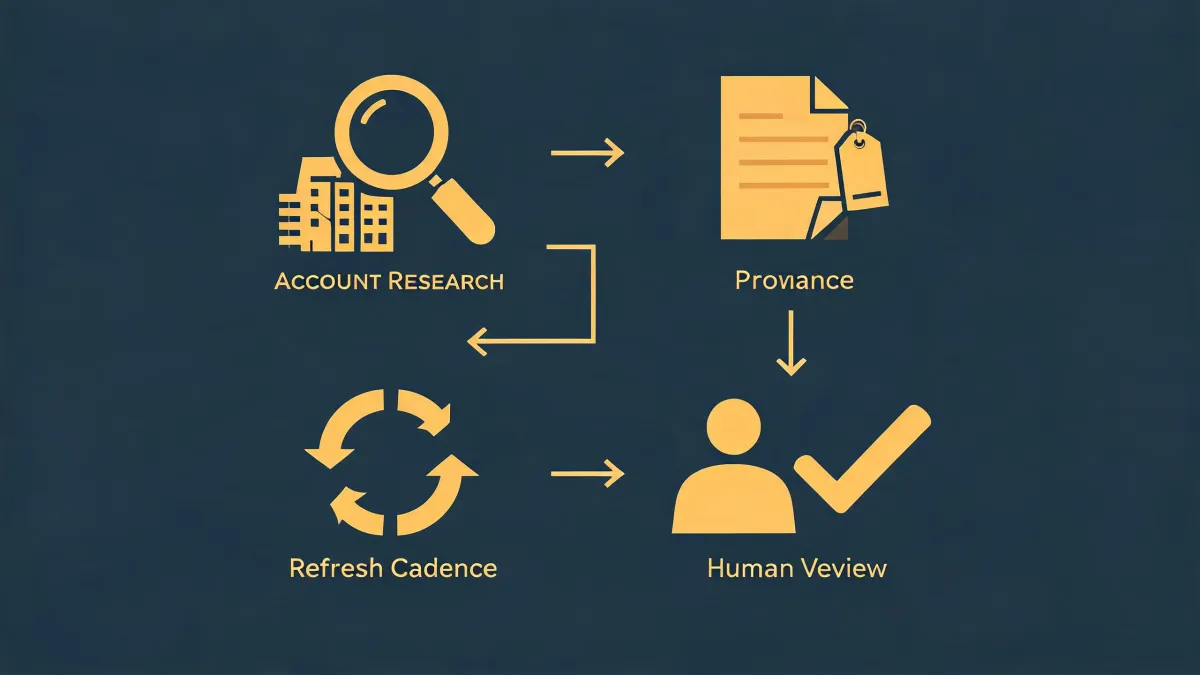
-
Is OKKI Go a Sales Prospecting Skill? I Don't Think So—And Here's Why That Matters for Your Budget
-
What OKKI Go Actually Does (From Someone Who Read the Docs)
-
The Cold Email Platform Question Most Teams Get Backwards
-
The Counterintuitive Part: Stronger Tools Make Weak Judgment More Expensive
-
The Pushback I Expect: "But AI Is Supposed to Replace Skills"
-
Who Should Actually Buy OKKI Go
-
Bottom Line
Is OKKI Go a Sales Prospecting Skill? I Don't Think So—And Here's Why That Matters for Your Budget
I run purchasing for a 240-person company. Roughly $340,000 annually across 14 software vendors. I don't do sales prospecting. But in October 2024, our VP of Sales asked me to review a budget request for OKKI Go, described in his email as "a tool that gives the team prospecting skills." I pushed back on that framing, and I want to explain why. OKKI Go is not a sales prospecting skill. It's infrastructure—a piece of technology that sits on top of skills your team either has or doesn't. Confusing those two things is how companies end up buying tools that collect dust. I've seen it happen three times in the past four years.
This isn't a knock on OKKI Go. It's actually a solid product. But "solid product" and "right purchase for you" are different questions, and I've learned the hard way that vendors rarely help you separate them.
What OKKI Go Actually Does (From Someone Who Read the Docs)
I spent about six hours over two weeks evaluating OKKI Go. Talked to two references the sales rep provided, watched a 45-minute demo, and skimmed the documentation on account research and sales signals. Here's the plain version: OKKI Go pulls together company data, contact information, and buying signals into one place. It does account research at scale—the kind of research a good SDR might do manually for 20 companies a day, but across hundreds or thousands. It uses waterfall enrichment, meaning it pulls from multiple data sources rather than relying on one. And it's built for agent-native prospecting—so the workflow assumes some level of automation and human-in-the-loop review.
What it doesn't do: write your opening lines. Decide which accounts are worth contacting. Interpret whether a hiring surge in a company's RevOps department actually means they need your product.
Those are skills. And I've now sat through enough tool evaluations to know the difference matters.
The Cold Email Platform Question Most Teams Get Backwards
Last quarter, I reviewed a different request—a B2B SaaS company's sales team wanted to buy a cold email platform because their reply rate had dropped to just under 2%. Their reasoning was simple: better tool, better results. I asked one question: who are you currently emailing? They showed me their list. It was every company in their CRM with more than 200 employees and a matching industry code. No segmentation. No sales signals. No account research beyond a LinkedIn search on the decision-maker's name.
That's the problem. Not the tool. The tool was going to amplify a process that was already broken.Here's what I recommended instead—and what I'd recommend to any team thinking about OKKI Go or a cold email platform: pick 50 target accounts. For each one, dig up one specific reason why this week might be the right week to reach out. New funding round. New sales leadership. A product launch in an adjacent category. Something concrete. Then write 50 emails that reference that specific thing.
Do that manually first. If your reply rate jumps meaningfully, then you know the skill exists—and a tool like OKKI Go can scale it. If it doesn't jump, no platform is going to fix it.
"The question isn't 'does this tool have good features.' The question is 'what skill does this tool amplify, and does our team have it?'"
The Counterintuitive Part: Stronger Tools Make Weak Judgment More Expensive
This is the part most people miss. A more powerful prospecting tool doesn't just make good prospecting better—it makes bad prospecting faster and harder to undo. When your team emails 100 prospects manually, mistakes stay small. You notice the pattern, you adjust, you move on. When your team uses OKKI Go to run account research across 5,000 accounts and trigger automated outreach, a bad targeting decision burns through your entire addressable market in a week.
I learned a version of this lesson years ago when I approved a bulk office supply order from a new vendor because the unit price was 22% lower. They sent the wrong weight paper. Twice. By the time we sorted it out, we'd burned through two weeks of productivity and I'd spent more in labor correcting the mistake than we'd saved. The vendor wasn't bad. My decision to skip the sample order was bad.
Same principle applies here. The tool isn't the risk. The unexamined assumption that "better tool equals better outcomes" is the risk.
The Pushback I Expect: "But AI Is Supposed to Replace Skills"
I've heard this from three different vendors now. The argument goes: AI tools are getting better at judgment, so eventually the skill requirement goes away. Just buy the tool and the skill will follow. I don't buy it. And I say that as someone who's watched a lot of "this changes everything" software pitches over the past four years. What AI actually does well is handle volume. It can research 500 accounts in the time a human researches five. It can identify patterns in sales signals across a massive dataset. It can draft variations of outreach that sound human enough to get read. What it doesn't do well is tell you which accounts matter in the first place. That's still a judgment call. It still requires understanding your market, your product's actual fit, and the messy context of what's happening inside a prospect's business right now.
If your team can't articulate why a specific company is a good fit, no amount of OKKI Go-powered account research is going to fix that. You'll just have more data supporting a decision you shouldn't be making.
Who Should Actually Buy OKKI Go
Here's my honest read. And I mean this as a genuine endorsement, not a hedge.
Buy OKKI Go if your team already does prospecting well manually—and you're hitting a ceiling on volume. If a rep can take five target accounts and consistently turn three into conversations, that's a skill. Give that rep OKKI Go and they can run the same process across 50 accounts. That's the multiplier.
Don't buy it if your team is struggling with fundamentals. If reply rates are low, if nobody can explain the last ten wins in terms of account research, if "sales signals" isn't a phrase anyone on the team uses in a normal sentence—fix that first. A tool won't teach prospecting. It'll just automate whatever your team is already doing.
One more thing. I'd rather see a team spend three months getting good at manual prospecting and then buy OKKI Go than see them buy OKKI Go on day one and hope the tool teaches them. I've approved both kinds of requests. The first kind works. The second kind usually ends up back in my inbox six months later as a churn decision.
Bottom Line
OKKI Go is not a sales prospecting skill. It's a piece of infrastructure that makes a prospecting skill scalable. That distinction isn't just semantic—it's the difference between a tool that pays for itself and one that becomes a line item you quietly cut next budget cycle. So before you sign the PO, ask yourself one question: what specific skill is this tool amplifying? If you can answer that clearly and honestly, you're probably making a good call. If the answer is vague, you're not buying infrastructure. You're buying hope.
And hope doesn't show up on the ROI report.

Matteo Ferraro
Matteo Ferraro is an independent sales engagement analyst covering sales sequences, cadences, multichannel outreach, power dialers, parallel dialers, task queues, and pipeline follow-up. He applies ISO/IEC 27001 access-control principles while measuring connect rate, reply rate, positive-response rate, meeting conversion, attempt density, queue latency, disposition accuracy, and unsubscribe completion. His workflow comparisons help outbound leaders choose engagement platforms, design fair performance baselines, and coordinate calls, email, and manual tasks without sacrificing governance or prospect experience.