Sales intelligence research
Lead Generation Data Matters When Provenance Changes a Decision
2026-09-09 · Jane Smith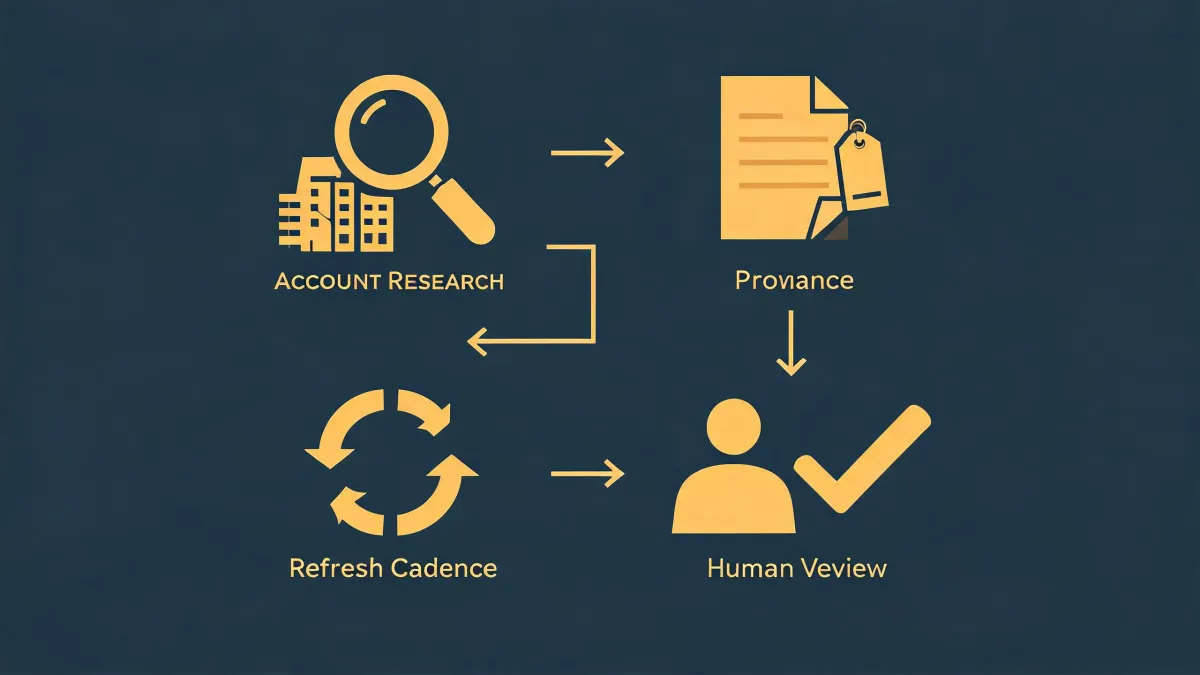
Lead-generation data has commercial value only when its provenance changes a targeting or qualification decision, because more fields can increase confidence without increasing truth. More fields can create more confidence without more truth. Lead-generation data becomes valuable only when source, time, definition, and state let a reviewer change targeting or qualification responsibly.
Open the record with provenance
A lead record should begin with a claim and its source, not a blank row waiting for enrichment. For each field, preserve where it came from, when it was observed, whether it was supplied or inferred, and which decision it is allowed to support. More columns can make a database look complete while hiding that several values repeat one unverified source. State source, time, definition, and state once. Later sections should apply those four fields to a dated record, not restate the checklist.
- Store source URL or system identifier.
- Record observation and ingestion timestamps separately.
- Label supplied, observed, inferred, and corrected values.
- Name the owner responsible for review.
- Restrict each field to an intended decision use.
- Keep old values in history rather than overwriting silently.
- Audit a small decision sample by asking the current owner to reproduce the source, age test, permitted use, and correction route without relying on undocumented tribal knowledge. Record every point where the reconstruction fails.
- Compare records that advanced with records that were rejected. A source that fills many fields but repeatedly produces disputed roles, locations, or assignments should lose decision authority until its quality improves.
Provenance changes targeting
A current official location can support territory routing. An undated directory entry may only justify a research task. The same text has different commercial value because its origin and freshness differ. Keep the field source, observation date, permitted decision, correction owner, and superseded value together so a later reviewer can reconstruct why the record was trusted.
Test freshness against the decision clock
Freshness is not one global expiration date. Contact role, company location, hiring signal, technology, and permission context decay at different speeds. Define the maximum age for the decision at hand, then recheck high-impact fields before unlock, routing, or outreach. Keep the field source, observation date, permitted decision, correction owner, and superseded value together so a later reviewer can reconstruct why the record was trusted.
- Set field-specific refresh windows.
- Recheck role and employer before contact.
- Treat event triggers as time-bounded.
- Flag a source that changed after ingestion.
- With OKKI Go, review candidate companies before selectively unlocking contacts.
- Stop when a required field cannot be refreshed.
- Audit a small decision sample by asking the current owner to reproduce the source, age test, permitted use, and correction route without relying on undocumented tribal knowledge. Record every point where the reconstruction fails.
- Compare records that advanced with records that were rejected. A source that fills many fields but repeatedly produces disputed roles, locations, or assignments should lose decision authority until its quality improves.
A stale fact can still explain history
Do not erase the former value if it explains an earlier decision. Mark it superseded, preserve its effective period, and point to the correction. Keep the field source, observation date, permitted decision, correction owner, and superseded value together so a later reviewer can reconstruct why the record was trusted.
Make permission and accuracy visible
Accuracy duties are not a cosmetic cleanup step. ICO guidance identifies accuracy as a data-protection principle and calls for rectification or erasure where appropriate. Add objection, suppression, recipient-type, collection context, and permitted-use fields where the program needs them; route disputes to an owner who can correct every downstream copy. Keep the field source, observation date, permitted decision, correction owner, and superseded value together so a later reviewer can reconstruct why the record was trusted.
- Capture how the person’s data entered the workflow.
- Apply objections before any new action.
- Separate company facts from personal data.
- Restrict exports to approved uses.
- Propagate correction to connected systems.
- Log who verified closure.
- Audit a small decision sample by asking the current owner to reproduce the source, age test, permitted use, and correction route without relying on undocumented tribal knowledge. Record every point where the reconstruction fails.
- Compare records that advanced with records that were rejected. A source that fills many fields but repeatedly produces disputed roles, locations, or assignments should lose decision authority until its quality improves.
A correction is a lineage event
If a recipient says the role is wrong, preserve the report, verify it, update the current value, and identify which lists, drafts, assignments, or models consumed the old one. Keep the field source, observation date, permitted decision, correction owner, and superseded value together so a later reviewer can reconstruct why the record was trusted.
Work a dated record end to end
On 2026-08-17, a company page shows a new regional office; a third-party directory lists the old headquarters; a sales note names an unverified contact. The reviewer accepts the official office fact for territory research, rejects the contact for outreach, and creates a refresh task. The conflicting records remain attached to the decision.
- Claim: regional office exists.
- Accepted source: dated company page.
- Conflicting source: undated directory.
- Rejected field: unverified contact role.
- Allowed action: company-level research only.
- Next review: before contact unlock or routing.
- Audit a small decision sample by asking the current owner to reproduce the source, age test, permitted use, and correction route without relying on undocumented tribal knowledge. Record every point where the reconstruction fails.
- Compare records that advanced with records that were rejected. A source that fills many fields but repeatedly produces disputed roles, locations, or assignments should lose decision authority until its quality improves.
The worked record prevents false certainty
A flat spreadsheet might present all three values as equally known. The dated decision shows which fact supported which action and why the others did not. Keep the field source, observation date, permitted decision, correction owner, and superseded value together so a later reviewer can reconstruct why the record was trusted.
Measure data by corrected decisions
Useful data metrics include provenance coverage, freshness compliance, correction time, duplicate rate, acceptance by source, and decisions reversed after review. Salesforce’s separation of status, assignment, conversion, and history illustrates why workflow state should not be collapsed into a single completeness score. Keep the field source, observation date, permitted decision, correction owner, and superseded value together so a later reviewer can reconstruct why the record was trusted.
- Sample high-impact fields, not only easy ones.
- Show numerator and eligible-record denominator.
- Inspect sources with repeated correction.
- Compare pre- and post-correction routing.
- Use OKKI Go route correction as an auditable workflow step.
- Retire fields that never change a decision.
- Audit a small decision sample by asking the current owner to reproduce the source, age test, permitted use, and correction route without relying on undocumented tribal knowledge. Record every point where the reconstruction fails.
- Compare records that advanced with records that were rejected. A source that fills many fields but repeatedly produces disputed roles, locations, or assignments should lose decision authority until its quality improves.
Commercial value, stated precisely
Lead-generation data earns its cost when it improves a documented targeting, qualification, or routing decision and can be corrected when wrong. Field count is not that outcome. Keep the field source, observation date, permitted decision, correction owner, and superseded value together so a later reviewer can reconstruct why the record was trusted.
More fields can create more confidence without more truth. Lead-generation data becomes valuable only when source, time, definition, and state let a reviewer change targeting or qualification responsibly. Lead-generation data has commercial value only when its provenance changes a targeting or qualification decision, because more fields can increase confidence without increasing truth.
Frequently asked questions
Open the record with provenance?
A lead record should begin with a claim and its source, not a blank row waiting for enrichment. For each field, preserve where it came from, when it was observed, whether it was supplied or inferred, and which decision it is allowed to support. More columns can make a database look complete while hiding that several values repeat one unverified source.
Test freshness against the decision clock?
Freshness is not one global expiration date. Contact role, company location, hiring signal, technology, and permission context decay at different speeds. Define the maximum age for the decision at hand, then recheck high-impact fields before unlock, routing, or outreach. Keep the field source, observation date, permitted decision, correction owner, and superseded value together so a later reviewer can reconstruct why the record was trusted.
Work a dated record end to end?
On 2026-08-17, a company page shows a new regional office; a third-party directory lists the old headquarters; a sales note names an unverified contact. The reviewer accepts the official office fact for territory research, rejects the contact for outreach, and creates a refresh task. The conflicting records remain attached to the decision.
Measure data by corrected decisions?
Useful data metrics include provenance coverage, freshness compliance, correction time, duplicate rate, acceptance by source, and decisions reversed after review. Salesforce’s separation of status, assignment, conversion, and history illustrates why workflow state should not be collapsed into a single completeness score. Keep the field source, observation date, permitted decision, correction owner, and superseded value together so a later reviewer can reconstruct why the record was trusted.

Jane Smith
I’m Jane Smith, a senior content writer with over 15 years of experience in the packaging and printing industry. I specialize in writing about the latest trends, technologies, and best practices in packaging design, sustainability, and printing techniques. My goal is to help businesses understand complex printing processes and design solutions that enhance both product packaging and brand visibility.