Sales intelligence research
Okki Go vs Apollo: A 72-Hour Outbound Story About Human Review and LinkedIn Automation
2026-09-18 · Erin Watanabe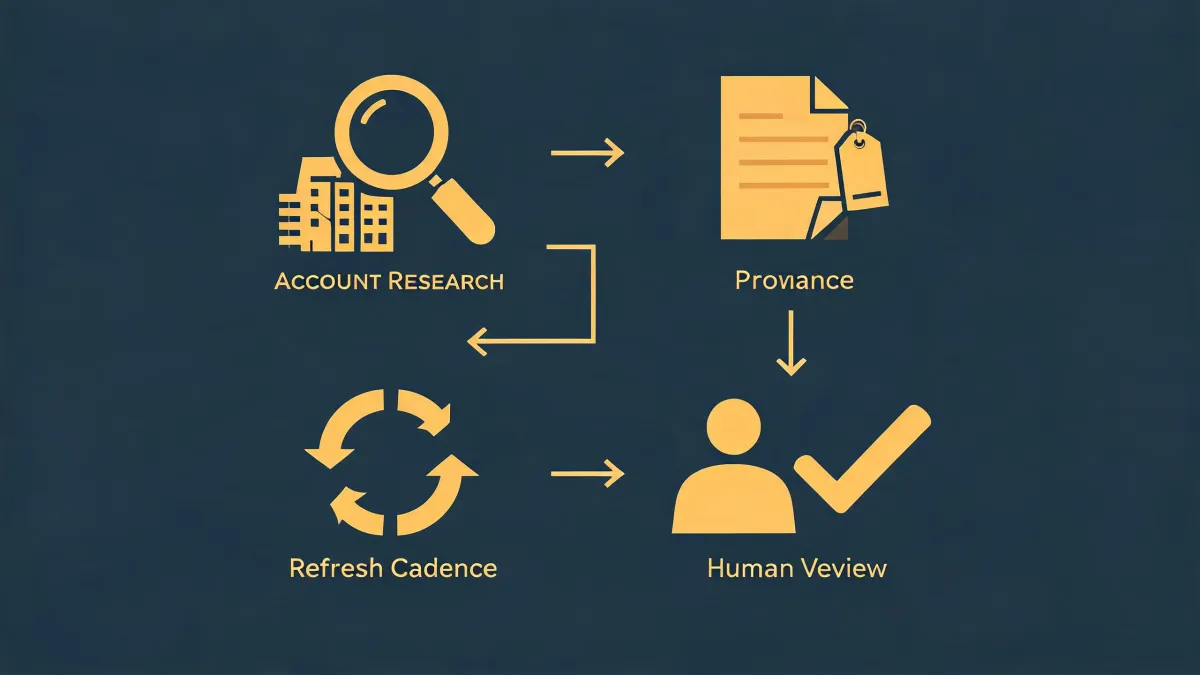
-
The 72-hour request that should not have worked
-
Wednesday: waterfall enrichment and the missing 112 emails
-
The human review workflow that saved us
-
What is a LinkedIn automation tool, and when should a B2B sales team use it?
-
Friday: the result and the uncomfortable comparison
-
Okki Go vs Apollo: what I would tell a small B2B team
-
What I learned
It was a Tuesday in March 2024, 9:14 a.m., when a three-person B2B sales agency called me. They sell a niche HR compliance tool to dental practices. Their webinar was Friday. They needed 500 targeted prospects in Texas, with verified work emails and a LinkedIn follow-up plan. Normal turnaround for that kind of list build is five business days. They had 72 hours. Then they asked the question I hate: Are we too small for this?
In my role coordinating rush outbound launches at a B2B sales tech company, I have handled 200+ rush orders in six years, including same-day turnarounds for seed-stage clients. Small teams are not a burden. They are often the best test of whether a workflow actually works. So I said yes, but only if we used a human review workflow. That decision turned into a messy, useful lesson about Okki Go vs Apollo, data enrichment features, email verification service, and when a LinkedIn automation tool makes sense.
The 72-hour request that should not have worked
The agency had Apollo already. Apollo is a solid broad sales intelligence platform. I am not going to trash it. But their export was rough: 600 rows, 112 missing direct emails, 47 rows with no clear job title, and a bunch of generic info@ addresses. Most buyers focus on list size and completely miss field-level match quality. That is the outsider blindspot. A list of 5,000 unverified contacts is not better than a list of 500 clean ones. It is just more expensive to clean up later.
We had been testing Okki Go (sometimes written okki-go) for agent-native prospecting. The pitch is not magic. It is waterfall enrichment plus intent signals plus human-in-the-loop outreach. For this rush job, that fit better than a pure database export. We did not choose Okki Go because Apollo is bad. We chose it because the workflow was built around review, not just volume.
Wednesday: waterfall enrichment and the missing 112 emails
At 6:30 a.m. Wednesday, we ran the agency's list through Okki Go. The data enrichment features filled in firmographic gaps first: practice size, location, role, and a few technographic signals (like role, company size, and location). Waterfall enrichment means the system tries multiple data sources in sequence instead of relying on one provider. That mattered because no single source had all 112 missing emails.
We got 41 of the missing emails from enrichment. Not 112. Not 100%. If a vendor promises perfect fill rates, walk away. The remaining rows went into a manual research queue (note to self: always check field-level match rates before promising a deadline). That took two hours, but it was worth it. We also flagged 19 records as risky and 11 as invalid through the email verification service. Verification is a risk reducer, not a guarantee. According to Google's email sender guidelines (support.google.com/mail/answer/81126), senders should keep spam rates below 0.3% and authenticate with SPF, DKIM, and DMARC. Verification alone does not do that. You still need domain warmup, relevant copy, and opt-out handling.
Under CAN-SPAM (ftc.gov), commercial emails must include an accurate header, a clear opt-out, and a physical address. We checked all three before anything left the building. For EU contacts, GDPR (gdpr.eu) requires a lawful basis for processing personal data. The agency was US-only, but we kept the process documented anyway. It is easier to build the habit than to retrofit it later.
The human review workflow that saved us
This is the part most rush projects skip. At 2:15 p.m. Wednesday, we pulled 40 sample emails and 20 LinkedIn messages into the Okki Go human review workflow. A real person read every one. We found three broken personalization tokens, two wrong job titles, and one message that sounded like a robot wrote it after a bad breakup. We fixed all of it before launch.
Human-in-the-loop is not a nice-to-have. It is the difference between a campaign that gets replies and a campaign that gets your domain blocked. The review queue also let us remove 12 contacts that enrichment had marked as high-fit but who had recently changed roles. Looking back, I should have set up the review queue before enrichment. At the time, I thought verification would catch the bad stuff. It caught syntax. It did not catch context.
What is a LinkedIn automation tool, and when should a B2B sales team use it?
The agency asked if we could just connect with all 500 people on LinkedIn. No. A LinkedIn automation tool schedules or assists profile actions like connection requests, messages, and profile visits. When it is used well, it helps a B2B sales team stay consistent on targeted accounts, follow up after events, or run account-based plays. When it is used badly, it becomes spam with a nicer dashboard.
LinkedIn's User Agreement (linkedin.com/legal/user-agreement) prohibits unauthorized scraping and automated access unless you have permission. So we did not scrape. We did not blast. We built a manual-approved queue: 20 to 25 connection requests per seat per day, each with a human-reviewed note. The agency's founder sent 60 invites to the best-fit accounts. Fourteen accepted. Six replied. That is not a benchmark, and I would never promise it. But it was enough to warm up the webinar list.
Use LinkedIn automation when you have a relevant reason to connect, a small target list, and someone who can review the messages. Do not use it when you are trying to replace judgment, bypass limits, or send the same paragraph to 2,000 strangers. That is not outbound. That is a support ticket waiting to happen.
Friday: the result and the uncomfortable comparison
By Thursday night, the sequence was live. Friday at 8:00 a.m., the agency had 38 webinar registrations from the outbound campaign and seven booked calls. The founder told me they had assumed small accounts got ignored. They had been quoted high minimums by two other vendors. That made me mad. Small does not mean unimportant. It means potential. When I was starting out, the vendors who treated my $200 orders seriously are the ones I still use for $20,000 orders. The same logic applies to list builds and outbound tools.
There is something satisfying about a rush launch that does not end in a deliverability fire. After all the stress and coordination, seeing the first positive reply come in on Thursday afternoon was the payoff. It was not a miracle. It was a workflow: enrich, verify, review, send, measure.
Okki Go vs Apollo: what I would tell a small B2B team
Okki Go vs Apollo is not a winner-take-all debate. Apollo is broad, established, and useful for general prospecting. Okki Go is agent-native, with waterfall enrichment, intent data, and a human review workflow that fit a rush job better. If you already live in Apollo and it works, keep it. If your team is small, your list is messy, and your deadline is tight, the review layer matters more than the database size.
Here is the short version I gave the agency:
- Ask about enrichment match rates, not just total contacts.
- Ask how the email verification service buckets results: valid, risky, invalid, unknown.
- Ask for a human review workflow before launch, even if it is just 25 sample records.
- Ask how the LinkedIn automation tool handles limits, opt-outs, and manual approval.
- Ask whether the vendor treats a 500-record list like a real project or a rounding error.
That last one is the small_friendly test. A good process should scale down, not just up. If a vendor cannot run a careful 500-contact campaign, they probably cannot run a careful 50,000-contact campaign either. They just have more room to hide mistakes.
What I learned
Looking back, I should have started the human review workflow before enrichment. If I could redo that decision, I would set up the review queue first, then enrich, then verify. But given what I knew then, my choice was reasonable. The rush forced us to learn fast.
If you are evaluating Okki Go vs Apollo, do not just compare databases. Compare workflows. Data enrichment features are only useful if someone checks the fields. An email verification service is only useful if you respect the risky bucket. A LinkedIn automation tool is only useful if you use it like a scalpel, not a bazooka. And a small B2B sales team deserves the same care as a large one. Small does not mean unimportant. It means potential.
Prices and platform policies change. Verify current rates, terms, and compliance requirements with the vendor and official sources before you launch. This was a real rush project, but your results will depend on your list, offer, domain setup, and market.

Erin Watanabe
Erin Watanabe is an independent CRM and revenue workflow analyst covering prospecting integrations, lead routing, sales pipelines, API synchronization, browser extensions, campaign attribution, and sales automation. She uses ISO/IEC 27001 control objectives while checking field mapping, sync latency, webhook reliability, duplicate rate, permission scope, error recovery, attribution consistency, and audit logs. Her systems guides help revenue operations teams connect acquisition tools, preserve trustworthy records, and evaluate whether automation reduces manual work without creating hidden data debt.