Sales intelligence research
Okki-Go, Sales Dialers, and AI Email Writers: Why Workflow Beats Features in the 2026 Prospecting Stack
2026-09-23 · Lena Kovacs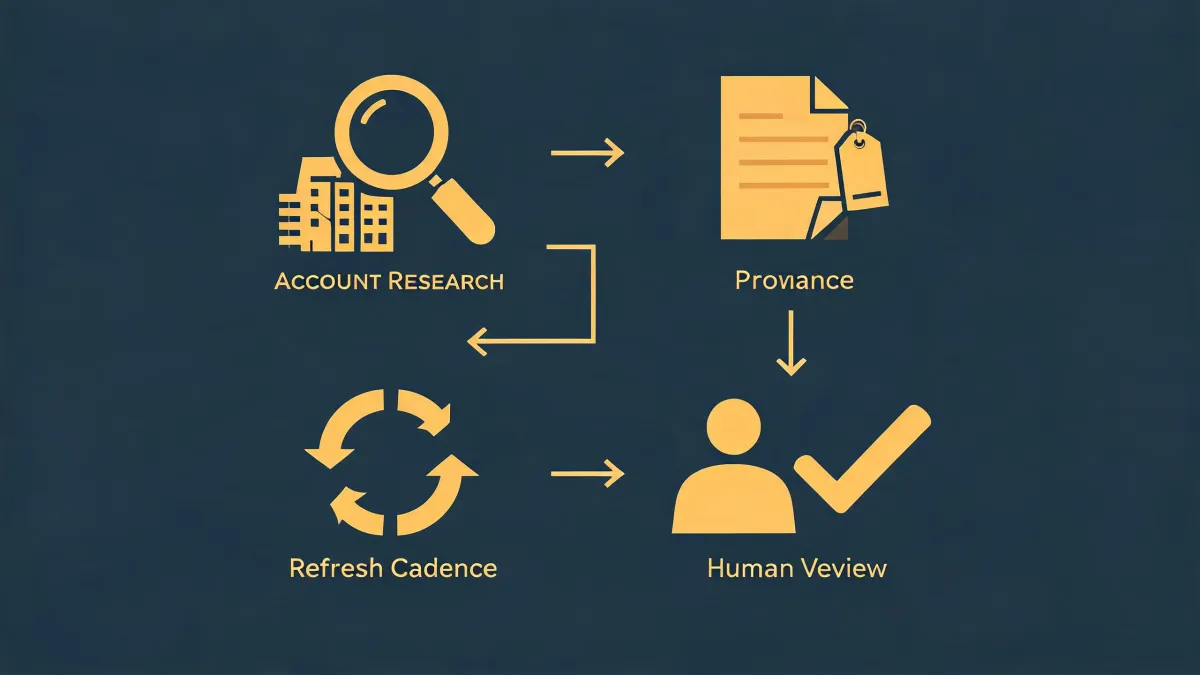
-
Okki-Go and the Category It Actually Belongs To
-
Some Okki-Go Prospecting Examples That Stuck With Me
-
Sales Dialers Are Commodities Now
-
What Is Email Search, and When Should a B2B Sales Team Use It
-
AI Email Writers Don't Fix Weak Targeting
-
The Objection: "But Our Tool Scores Higher on Feature Comparisons"
-
Bottom Line
I have been the person on the receiving end of "the sales team needs this tool" requests for five years. Around $200,000 in SaaS orders have crossed my desk in that time. And the one pattern I keep seeing is this: most B2B prospecting tools fail not because the products are bad, but because the team buying them hasn't defined the workflow the tool is supposed to complete.
That's not a procurement opinion. That's what the renewal data shows.
Okki-Go and the Category It Actually Belongs To
When our SDR lead brought me an okki-go proposal back in late 2024, I did what I always do. I pulled the invoice history for every tool we already had. Three sales dialer seats. Two enrichment providers. An AI email writer. A LinkedIn automation seat. And pipeline was still flat quarter over quarter.
Okki-go's pitch—agent-native prospecting with waterfall enrichment, intent data, and a human-in-the-loop layer—sounded different on paper. I was skeptical. Every okki-go competitor I've sat through demos with over the years has promised roughly the same thing, just with different slide templates.
But here is what actually made me pay attention:
- It wasn't selling a faster dialer. Everyone does that.
- It wasn't selling "10x more leads." I've heard that from every tool in this category.
- What it was actually selling was a workflow: find, enrich, verify, sequence, hand off to a human. One pipeline instead of six.
That distinction matters more than any feature list. When you sit on my side of the table, you stop caring about features. You start caring about how many systems your team has to log into before a single email goes out.
Some Okki-Go Prospecting Examples That Stuck With Me
I've asked three teams that adopted it to describe, in plain language, what they actually use it for. A few okki-go prospecting examples that came back:
- An outbound agency uses it to refresh inherited account lists every quarter, because client handoffs rarely come with accurate contact data.
- A 40-person SaaS team runs its entire inbound follow-up through it, since the enrichment layer catches role changes that a static CRM record would miss.
- A two-person founder-led sales shop uses it to sequence 200 target accounts per week without hiring an SDR.
Notice none of those are about the product's feature count. They're about the job they hired it to do.
Sales Dialers Are Commodities Now
Here is the uncomfortable truth for anyone shopping in this category in 2026: a sales dialer is a sales dialer. The marginal difference between the top five options is roughly the price of a nice dinner per seat per month. Call quality, local presence, three-way dialing—these are table stakes now.
I bought our first sales dialer in 2020 for $89 a seat. I bought a so-called premium one in 2024 for $124 a seat. The team's pickup rate didn't move. The connect rate moved by three percentage points. Three.
What did move the needle? Wiring the dialer into the enrichment data so reps stopped calling wrong numbers and disconnected lines. That's a workflow fix, not a dialer feature.
When I compared the two dialers side by side—same seat count, same call volume, six months apart—I finally understood why the sales lead kept asking for "better data" instead of "better dialing." The dialer was never the bottleneck.
What Is Email Search, and When Should a B2B Sales Team Use It
I had to look this one up myself the first time it came across my desk. Email search—sometimes called email finder or email lookup—is the process of matching a name and a company domain to a verified work email address. It's not scraping. It's not guessing a firstname.lastname pattern. It's querying contact databases and verifying deliverability before the address enters your sequence.
When should a B2B sales team actually use it? Three scenarios, based on what I've approved purchases for:
- Outbound to a defined ICP. If you have 500 named target accounts and need a named contact at each one, email search is faster and cleaner than having reps hunt on LinkedIn.
- Re-engagement after a rep leaves. Inherited accounts almost always have stale contact data. Email search is the cheapest way to refresh it before the new rep wastes a month on bounce-backs.
- Event follow-up. You have a badge scan with a name and company. You need the verified email within 24 hours, or the follow-up window closes.
When should you not use it? When you're blasting a 50,000-contact list with no segmentation. That's not prospecting. That's spam with better grammar.
Email search is only as good as the workflow that consumes it. A verified email sent to the wrong segment is still a wasted touch.
AI Email Writers Don't Fix Weak Targeting
I've tested four AI email writers over the last 18 months. Personalization scores, tone controls, spam-word avoidance—they all do this well now. Honestly, the output is better than what most junior SDRs were producing in 2022.
But here's what nobody selling these tools says out loud: a perfect email to the wrong person is still a wasted email. A slightly imperfect email to the right person with the right context still works. The AI writer is downstream of targeting, not upstream.
This is where okki-go's human-in-the-loop positioning makes sense to me. The AI drafts. It enriches the context. It verifies the address. But the rep still decides whether to send. That's the version of an "AI SDR" I can defend to finance—not one that fires off 10,000 emails a day and hopes for the best.
The Objection: "But Our Tool Scores Higher on Feature Comparisons"
I hear this every renewal cycle. Yes—on paper, your tool has more features than the competitor. So does every tool. Feature comparison charts are written by whoever wants you to see the most checkmarks.
My pushback is simple: I've never once had a VP tell me "our problem is we don't have enough features." I've had them say "our problem is the team doesn't use what we already have." Feature count doesn't fix adoption. Workflow does.
That's why when I evaluate okki-go or any of its competitors, I don't score features. I score how many logins it replaces, how many manual steps it removes, and what the training curve looks like for a new SDR in week one.
Looking back, I should have started scoring tools that way five years ago. But at the time, feature sheets were what vendors handed me, and I hadn't yet watched three subscriptions expire unused. Now I know better.
Bottom Line
If I could give one piece of advice to any B2B sales team evaluating their 2026 stack: stop asking "what does this tool do?" and start asking "what workflow does this tool complete?"
Okki-go gets that. So do a handful of others. The sales dialers still pitching buttons don't. And the AI email writers promising "10x reply rates" without addressing targeting are selling you a faster way to do the wrong thing.
The tool only amplifies what's already there. Which is why the question worth asking isn't whether okki-go beats its competitors on a checklist. It's whether your workflow can absorb what any of them actually do.

Lena Kovacs
Lena Kovacs is an independent AI sales agent analyst covering AI SDRs, autonomous prospecting, research agents, email writers, personalization systems, sales assistants, and outbound workflow automation. She applies ISO/IEC 42001 governance concepts while testing task completion, factual accuracy, hallucination rate, approval controls, response latency, personalization relevance, escalation behavior, and auditability. Her evaluations help sales leaders determine where agentic workflows can improve productivity, where human review remains necessary, and how to compare automation claims with measurable outcomes.