Sales intelligence research
What Should RevOps Teams Evaluate in a B2B Contact Data Platform? (Okki-go vs. Clay and the Questions Most Teams Skip)
2026-09-03 · Jane Smith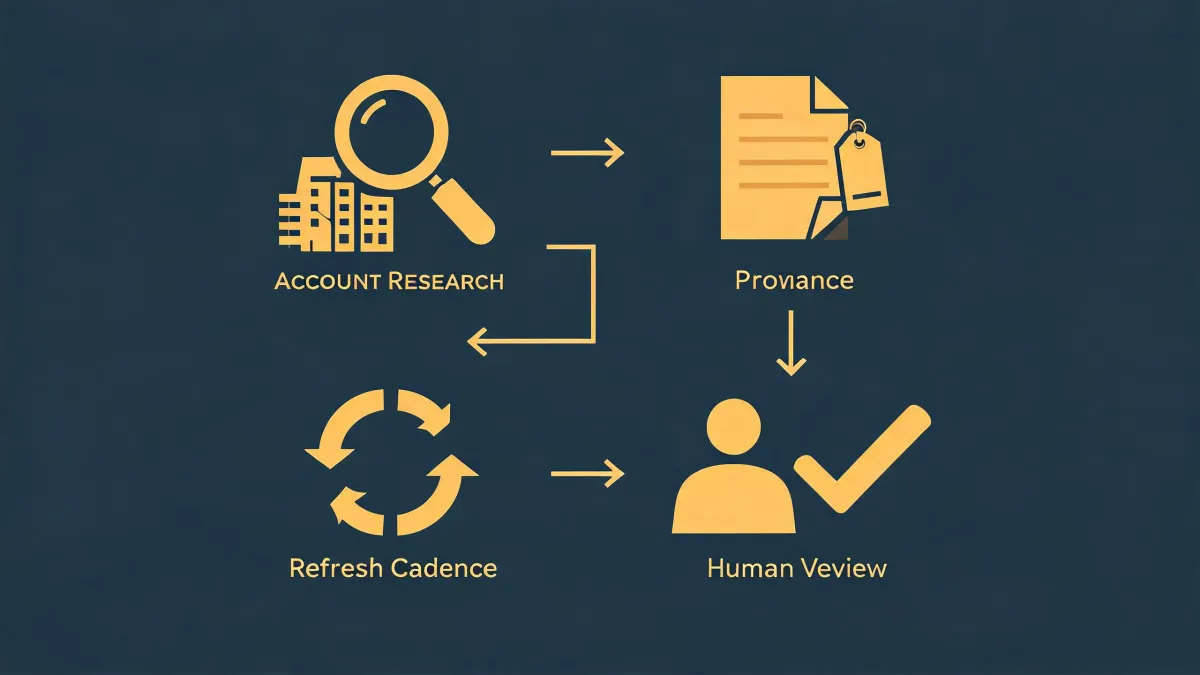
I've spent the past five years on the quality side of B2B data—reviewing vendor files, testing accuracy, and rejecting deliverables that don't meet spec. Before that, I ran RevOps for a company that made the same mistake twice. So when someone asks me "Okki-go vs. Clay, which one has the bigger database?" I stop them.
Because that's the wrong question.
Everyone Starts With the Spec Sheet
The typical buying conversation starts like this: one vendor says they have 250M contacts, another says 350M. One offers 10,000 enrichment credits a month. Another has a lower price. Your team makes a comparison table, runs a few test uploads, and picks the one with the highest match rate on a sample of 100 records.
That feels responsible. But after years of auditing data vendor deliverables, I've learned that the spec sheet is the least reliable part of the evaluation.
Match rate on a sample doesn't tell you what the match rate will be on your ICP, in your workflow, at your volume.
It took me three years and about 120 vendor audits to understand that. The real issue isn't comparing databases—it's that RevOps teams are often evaluating the wrong object entirely.
The Deeper Problem: You're Evaluating a Static List in a Live Revenue Engine
A contact database is not a product. It's an input to a sequence of decisions: who to email, who to call, who to route to a sales rep, who to re-approach after a buying signal changes.
When you compare only the raw data fields, you miss four things that determine whether the data will actually generate pipeline.
1. Usable Coverage Is Not the Same as Total Coverage
A platform might have 300 million records. But how many of them have a confirmed email, a dialable phone, and a company profile that matches your ICP?
In one of our QA rounds, we sampled 10,000 records from a major provider. Total match rate looked fine at 92%. But after filtering for valid email syntax, corporate domain deliverability, and active company size, the usable rate was under 41%. That's a very different number.
If a sales team is paying for raw coverage, they're paying for rows they cannot use.
2. You're Testing a Sample—Vendors Choose That Sample
When a vendor says "try us," they usually let you search a few accounts. Those accounts tend to be well-known companies with clean data. That's not a random sample. It's a showcase.
I once assumed a vendor's proof-of-concept results would carry over to our worst-fit accounts—the mid-market industrial companies we were trying to break into. Didn't verify. Turned out the vendor's data on those verticals was much weaker. We signed, wasted $14,000, and spent two quarters repairing the CRM.
Now we always run a blind test on our bottom 20% of ICP accounts, not our top 20%.
3. Static Data Can't Tell You When to Reach Out
A contact record is more useful when it comes with context. Are they hiring for a sales role? Did they just hire a new VP? Are they searching for tools in your category?
RevOps teams often forget that the best list in the world is worthless if it's used at the wrong moment. Data platforms that only give you a static spreadsheet force your SDRs to layer on separate intent and trigger tools manually—if they remember to do it at all.
4. You're Ignoring How the Data Will Be Used in the Workflow
Some platforms are great for a single power user who manually exports CSV files and uploads them to Outreach. Others are built for AI-assisted outreach: they can enrich, verify, score, and push contacts directly into your sequence engine without a human touching every row.
That distinction matters for RevOps teams—but it doesn't show up in a feature checklist.
What It Costs When You Evaluate Wrong
Here's what usually happens when a RevOps team picks a database like it's buying printer paper:
- The SDR team imports 50,000 records with a 25% invalid email rate. Bounces mount, sender reputation dips, and reply rates fall below the threshold needed to book meetings.
- Sales reps lose confidence in "the database" and start doing manual LinkedIn research instead. Workflow falls apart.
- Management sees low pipeline and blames the tool—but the tool was never measured against real usage.
In a recent audit of a client's outbound process, we found that 62% of their CRM contacts had no current email status and 34% had outdated company size data. Their sales team had spent four months calling on old intent signals. The data platform wasn't bad—it was just bought before they defined what "good" meant in their workflow.
The financial damage is obvious. The less obvious cost is your team's willingness to trust any data in the future.
What RevOps Teams Should Evaluate Instead
If I had to design a B2B contact data platform evaluation from scratch, it would look less like a spec sheet and more like an audit protocol.
Ask for source transparency and refresh dates
Don't just ask how many contacts a vendor has. Ask: where did this contact come from? When was the email last verified? How often is your firmographic data updated?
Run a real ICP test—not a pretty sample
Pick 500 accounts that look like your ideal customer—including the ugly ones. Upload them to the platform. Check match rate, valid email rate, and phone contactability.
Then ask what happens when a record doesn't match. Does the system enrich it from secondary sources? Does it tell you it's missing? Or does it just give you nothing?
Understand the enrichment philosophy
This is where platforms like Okki-go and Clay differ more than people expect.
Clay is a wonderful, flexible canvas. If you want to build custom enrichment workflows, compare data sources side by side, and have your team micromanage each step, it's a strong choice.
Okki-go is built around agent-native prospecting. It treats contact data as one part of an automated pipeline: enrich, verify, add intent context, and push usable leads into sequences without a person manually stitching every tool together. The waterfall enrichment approach isn't just about having more emails—it's about giving your AI SDR a complete record fast.
Neither is objectively better. They're designed for different operating models. A bigger database only matters if it works inside the way your team actually sells.
No database will save a broken outbound process. But a good data platform will expose where the process is broken.
Check whether the platform supports human-in-the-loop review
Even in AI-assisted outreach, someone needs to verify strategic accounts. Can the system flag the 50 accounts that deserve a personalized approach? Can your RevOps manager step in and correct a record without breaking the automation flow?
That's the difference between a tool you use and a system you run.
Bottom Line
Stop asking "which database has more contacts" or "Okki-go vs. Clay—who wins?" Those are the wrong questions.
The right question is: what percentage of records in this platform can my team use tomorrow to book a meeting?
After years of auditing data vendors, I've come to believe that the 'best' contact data platform is always context-dependent. It depends on your ICP, your stack, your outbound volume, and how much manual work you're willing to accept.
This is accurate as of early 2025. The data platform space moves quickly, so verify current capabilities before you commit—but spend your verification dollars on real ICP tests, not pretty product tours.

Jane Smith
I’m Jane Smith, a senior content writer with over 15 years of experience in the packaging and printing industry. I specialize in writing about the latest trends, technologies, and best practices in packaging design, sustainability, and printing techniques. My goal is to help businesses understand complex printing processes and design solutions that enhance both product packaging and brand visibility.