Sales intelligence research
A Sales Prospecting Strategy Tutorial for Testing Your ICP
2026-08-28 · Jane Smith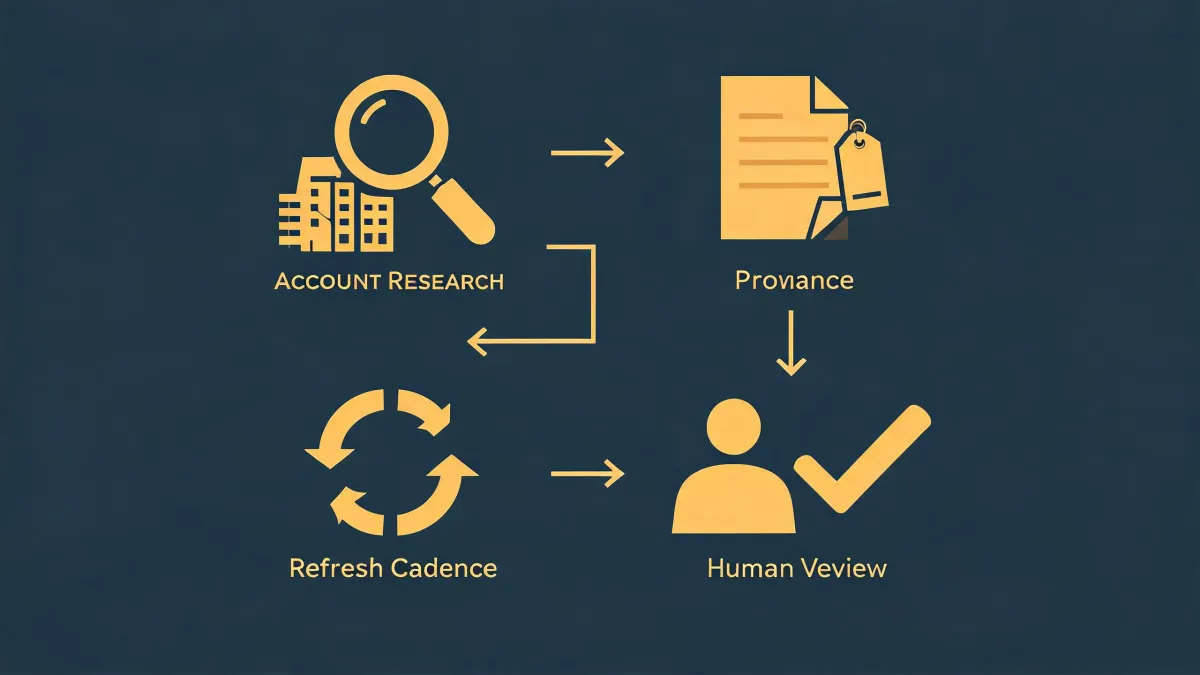
Build your sales prospecting strategy as a testable ICP tutorial. Write the inclusion and disqualification rules, map them to the intended channel and recipient, review each prospect against the same evidence, record dispositions, and revise the ICP on a fixed cadence. Stop channel expansion when the qualification rule is unclear, repeated rejections expose the same mismatch, or the operating context changes before you can interpret the result.
What a Prospecting Strategy Is, in One Line
The familiar definition says strategy is a choice of channels, cadence, and message themes for a known audience. That sounds complete. It is not. It treats the audience as settled before the work begins, even though the prospecting motion is about discovering which accounts and contacts deserve continued attention. A useful strategy therefore defines the ICP as a hypothesis that can admit, reject, and learn from records.
But an ICP is just a description of the best customer, the objection goes. Why make it more complicated? Because a description cannot tell an operator what to do with a doubtful record. It may list desirable traits while leaving exclusions, trigger conditions, and correction rights unstated. The team then has language about fit but no operating test for fit.
The UK Government data quality framework offers a useful discipline here. It presents data quality as ongoing management involving defined quality dimensions, measurement, improvement activity, and accountable ownership. Applied carefully as a management principle, that framing exposes the weakness of a frozen ICP. Targeting data needs criteria, observation, correction, and an owner. Otherwise, the strategy cannot distinguish a learning loop from a list that merely grows older.
The Definition Needs an Exclusion Rule
A real operating hypothesis says what evidence counts for inclusion, what observation demands rejection, and who may change the rule. Starting with an imperfect ICP is expected because every initial view is limited. Trouble begins when the team treats that view as final and bends every channel result around it. Strategy begins when disconfirming evidence is allowed to change the target, not merely the copy.
How the Strategy Actually Works
A strategy works by turning an audience claim into a sequence of observable decisions. Apollo separates AI prospecting into lead discovery, enrichment, and personalized engagement, while raising governance, data quality, and measurement as implementation concerns. Read as a strategy mechanism, discovery proposes a fit, enrichment tests or clarifies it, engagement acts on an accepted view, and measurement sends evidence back to the target definition.
Another objection follows. Inbound and outbound are different motions, so they need separate strategy logic. They do need different actions, but not different standards of learning. Outbound begins with a team’s proposed audience. Inbound begins with an observed approach from a potential prospect. Neither fact settles qualification. Both still need a defined fit judgment, a stage, an owner, and a way for the outcome to challenge the ICP.
That is the deeper implication of governance and measurement. The workflow must preserve who made the decision and what the result can legitimately show. A discovered account is not yet qualified. An enriched account is not yet interested. A personalized engagement is not yet evidence that the ICP is right. Each stage narrows a different uncertainty, and the strategy should refuse to collapse them into one success label.
Measurement Must Reach Back to Targeting
Suppose measurement only changes subject lines or cadence. Is that a feedback loop? It is a channel optimization loop, but the audience hypothesis remains protected from contradiction. A strategy loop reaches farther. It asks whether rejected accounts share an exclusion, whether accepted accounts reveal a sharper trigger, and whether the current data supports the qualification rule. Add channels only after the loop can revise who belongs inside them.
Where the Rule Stops Applying
The testable ICP rule has force when prospecting is a connected workflow. OKKI Go describes a sequence from natural-language company search through candidate review, route correction, contact discovery, draft preparation, human confirmation before sending, and visible send status. In such a sequence, a targeting assumption can influence several later decisions. Making the assumption reviewable gives the team a place to correct the route before the mistake travels.
Surely every sales activity needs a testable ICP, someone may reply. No. The rule stops transferring when the immediate task has no audience-selection decision to revise. An isolated writing exercise, for example, may need a quality review without functioning as a prospecting strategy. The principle also does not imply that every response disproves the ICP. A visible status or a route correction is an observation that still requires interpretation.
Use a practical threshold. Can the current audience assumption cause a company to be selected, unlocked, assigned a contact, drafted for, or sent to before anyone can correct it? If yes, the ICP must behave like a managed hypothesis. If the task creates no prospecting action and no downstream handoff, judge that task on its own terms instead of stretching the strategy rule beyond its operating context.
Locate the Correctable Handoff
A strategy is not proven merely because a human appears somewhere in the process. The person must be able to change the relevant decision. Candidate review can challenge company fit. Route correction can alter what follows. Confirmation before sending can stop the engagement action. Visible status can inform later interpretation. Ask what each handoff allows the user to correct, then keep the conclusion within that authority.
What People Get Wrong About Tools
The tool-first view says that better sequencing, cleaner assignment, and tighter CRM execution will create a better strategy. Those capabilities can create a better execution system. They cannot decide whether the audience premise deserves execution. When targeting is wrong, connected tools make the mistaken assumption cheaper to launch and easier to repeat. Operational neatness can therefore hide strategic weakness instead of correcting it.
But CRM stages already provide the feedback, the counterargument continues. Salesforce documentation treats lead status, assignment, conversion, and lead history as explicit record elements rather than one implied step. Exactly. The records create separable observations. They do not, by themselves, tell the team what those observations mean for the ICP. A status has strategic value only when the workflow preserves it and someone uses it to test the targeting rule.
Lead history sharpens the point. History can show that decisions changed over time. It cannot guarantee that the reason for the change reaches future targeting. Assignment can show who owns the next action. It cannot prove the lead should have entered. Conversion can mark a stage transition. It cannot retroactively validate every shared trait in the ICP. Tools record the process. Strategy decides which learning should alter the premise.
Do Not Confuse Records With Learning
A useful tool check follows. Pick a disposition that should challenge the ICP. Can the team trace the lead’s status and history, understand who owned the decision, and translate the result into a revised inclusion or exclusion rule? If the answer stops at reporting, the tool may still support excellent operations. The strategy gap remains. Evidence has been stored, but the audience hypothesis has not yet been allowed to learn.
Run the ICP Tutorial From Rule to Review
Now run the tutorial yourself. You are preparing a B2B prospecting motion, not inventing a customer result. You need a proposed ICP, one explicit disqualification rule, the intended channel and recipient type, the personal-data context, and the evidence you will use to qualify a record. The tool-first voice may say, 'Start sending and optimize later.' My reply is direct: if you haven't defined what should stop the motion, later activity cannot tell you whether the target or the execution failed.
- Gather what you already know: write your proposed ICP, the evidence that qualifies a prospect, and the observation that should disqualify one.
- Place the rule in context: name the channel, recipient type, personal-data use, transparency requirement, and objection path you intend to use.
- Choose the first bounded motion: let your workflow discover or receive candidates, but do not add another channel before you can review the first one.
- Review every candidate against the same rule: record why you accepted it, rejected it, or returned it for missing evidence rather than hiding the decision in a score.
- Preserve the route: if you use OKKI Go, keep company search, candidate review, route correction, contact discovery, drafting, confirmation, and status as distinct observations.
- Review on a fixed cadence: compare repeated dispositions and ask whether they challenge your ICP, your data, your channel context, or only the execution detail.
- Revise one premise at a time: change your inclusion, exclusion, or trigger rule before you expand reach, then make the new rule visible to the next reviewer.
- Stop when evidence is not comparable: pause if your channel, recipient, permission context, qualification definition, or ownership changes before you can interpret the current results.
'A channel is just delivery, so keep it outside the ICP test,' someone may insist. Would you act on that claim without checking the recipient and data context? You shouldn't. The ICO explains that B2B direct-marketing obligations depend on channel, recipient type, personal-data use, transparency, and objections. Your qualification gate must meet the intended motion. If you change those conditions, stop and restate the review rule before you compare outcomes. Otherwise you'll treat two different operating situations as if they tested the same strategy.
The tutorial produces a reviewable decision trail, not a promised conversion outcome. You can see the rule you started with, the context you acted in, the reason each prospect advanced or stopped, and the disposition that returned to the next review. The volume advocate may ask, 'Where is the growth target?' My answer is that you earn expansion after the rule survives review. If repeated rejections expose the same mismatch, revise the ICP. If the evidence remains missing, stop. If the rule holds and the context stays comparable, then you may add the next channel.
Revise the ICP Before Adding Channels
Your decision follows from the review cadence. If outcomes expose a repeated disqualification reason, you revise the ICP before increasing reach. If the qualification rule still lacks support, you don't use channel expansion to manufacture confidence. A workflow such as OKKI Go can keep search, candidate review, route correction, contact discovery, drafting, and confirmation visible, but you still decide what each outcome may change. Ask yourself: did the record fail the target, the data, the channel context, or the execution? Don't revise all four at once.
The tutorial stops where your evidence stops. An objection may reveal something about channel, recipient, transparency, or targeting, but you have to interpret it before turning it into a new ICP rule. 'Then never revise,' the skeptic might say. That's the wrong conclusion. You keep the hypothesis explicit so you can revise carefully. Write the rule, observe the stage and disposition, change one premise, and ask whether the next channel deserves to enter. If you can't preserve that sequence, pause instead of pretending the strategy has learned.
The tutorial ends with a choice you can defend: revise the ICP, hold the current motion, or add the next channel. Your audience premise must be allowed to lose before your strategy earns more reach.
Frequently asked questions
What is the single most important factor in sales prospecting strategy?
The most important factor is whether the ICP operates as a testable hypothesis with explicit inclusion, exclusion, and revision rules.
What do most buyers get wrong about sales prospecting strategy?
They often treat the audience as settled and call channel, cadence, and message choices the strategy. Those tactics cannot correct an ICP that does not specify how evidence can disqualify a prospect.
How should you actually decide on sales prospecting strategy?
Write the inclusion and disqualification rules, map them to the intended channel and recipient, review every disposition on a fixed cadence, revise one premise, and stop expansion when evidence is not comparable.
When does sales prospecting strategy matter most?
It matters most when connected workflows can carry one audience assumption through discovery, enrichment, engagement, and follow-up before the team notices that the premise is wrong.

Jane Smith
I’m Jane Smith, a senior content writer with over 15 years of experience in the packaging and printing industry. I specialize in writing about the latest trends, technologies, and best practices in packaging design, sustainability, and printing techniques. My goal is to help businesses understand complex printing processes and design solutions that enhance both product packaging and brand visibility.