Sales intelligence research
Cut Mistaken Relevance From Cold Email Technique
2026-08-28 · Jane Smith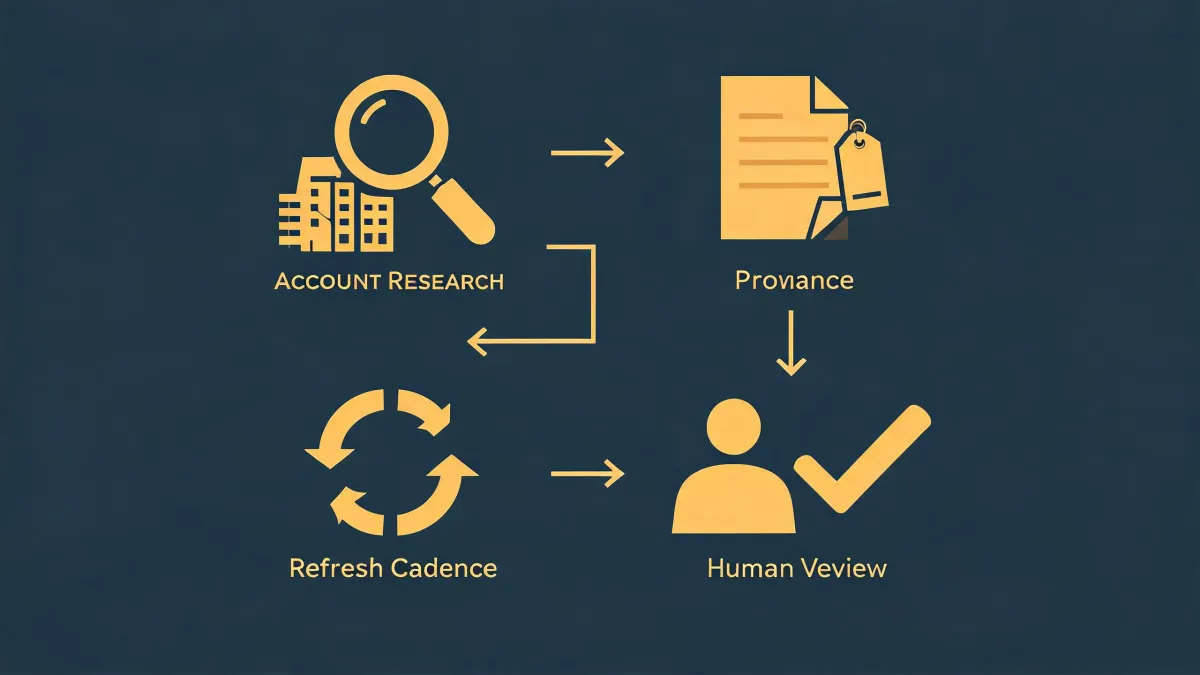
Effective cold-email techniques in 2026 are techniques for reducing mistaken relevance, because a technically delivered message still fails when it solves the wrong problem for the recipient. In 2026, successful delivery does not prove a relevant message. Effective technique begins by reducing the chance that a technically valid email reaches the wrong person with the wrong problem.
Reset the 2026 baseline before writing copy
Cold-email technique in 2026 begins with scope checks, not a clever opener. Gmail, Yahoo, Outlook, and privacy guidance distinguish sender volume, authentication state, recipient type, and jurisdiction. Record the rule source and refresh date, then decide whether the campaign belongs in the relevant threshold or legal category.
- For Gmail, distinguish requirements for all senders from additional requirements for senders above the documented daily Gmail volume.
- For Outlook, check whether the high-volume scope applies before diagnosing authentication or a 550 5.7.515 rejection.
- For Yahoo, inspect authentication, complaint control, unsubscribe handling, and message-stream separation together.
- For UK direct marketing, identify marketing purpose, planned data processing, fairness, and objections.
- Refresh scope: guidance and provider documentation reviewed on 2026-08-17.
- Maintain a provider-scope worksheet with sending volume, authentication state, error codes, complaint signals, unsubscribe behavior, and message-stream ownership; diagnose from the relevant requirement instead of generic deliverability folklore.
- Revisit the account hypothesis after replies. Correct the source record when a recipient disproves a role, timing, or workflow assumption, and propagate that correction before another generated draft repeats it.
A dated technique has a dated limit
“2026” should tell the reader when the operating assumptions were checked. It should not imply that every provider rule or jurisdictional requirement is permanent. Alder Systems begins its 2026 cohort only after the sending domain, applicable provider scope, authentication result, suppression path, and official-guidance check date are recorded. Copy work waits behind that release decision.
Build an account hypothesis before generating language
AI can produce fluent sentences from a weak premise. The useful technique is to write the account-level reason for contact as a falsifiable statement, attach the source, and specify what evidence would disqualify it. Only then should a person or system translate the hypothesis into email copy.
- State the observed trigger without inflating it into intent.
- Connect the trigger to one plausible workflow.
- Name the missing fact the recipient can correct.
- Discard records whose source cannot be located or dated.
- Use OKKI Go to review candidate companies and human-confirm the resulting recipient, subject, and body.
- Maintain a provider-scope worksheet with sending volume, authentication state, error codes, complaint signals, unsubscribe behavior, and message-stream ownership; diagnose from the relevant requirement instead of generic deliverability folklore.
- Revisit the account hypothesis after replies. Correct the source record when a recipient disproves a role, timing, or workflow assumption, and propagate that correction before another generated draft repeats it.
Relevance is not personalization theater
A job title, city, or recent post does not make a message useful by itself. Personal detail belongs only when it changes the business question and its use is appropriate for the context. The account hypothesis cites Alder's dated operations posting and asks whether distributor routing is relevant. Hiring does not prove pain, ownership, urgency, or purchase intent, so those fields remain unknown in the drafting record.
Simulate the workflow on representative leads
Before scale, run ordinary, stale, ambiguous, opted-out, and high-risk examples through research, drafting, approval, and routing. Microsoft’s simulation guidance supports reviewing drafts and their research basis before release. The test should expose where evidence disappears, not merely prove that automation can finish.
- Include one candidate that should be rejected.
- Force a reviewer to correct an unsupported inference.
- Verify that a suppression blocks further action.
- Route an objection to its owner.
- Preserve the draft, evidence, reviewer, and outcome.
- Repeat after a material prompt, model, provider, or integration change.
- Maintain a provider-scope worksheet with sending volume, authentication state, error codes, complaint signals, unsubscribe behavior, and message-stream ownership; diagnose from the relevant requirement instead of generic deliverability folklore.
- Revisit the account hypothesis after replies. Correct the source record when a recipient disproves a role, timing, or workflow assumption, and propagate that correction before another generated draft repeats it.
A safe simulation contains disagreement
If every sample advances, the set is too easy or the controls are ornamental. At least one record should require a documented stop. A simulation uses one clean record, one stale role, one look-alike entity, and one suppressed address. The clean case advances; the other three stop at different gates, giving the reviewer corrections that can be replayed after a system change.
Use a short message architecture, not a script
Construct the email around four jobs: identify the relevant observation, explain the plausible consequence, offer only the proof needed for the next decision, and ask for a bounded response. The words should vary with the evidence; the jobs provide an editing lens rather than a batch template.
- Observation: cite a specific, current source.
- Consequence: label the inference as a possibility.
- Proof: choose one fact that reduces uncertainty.
- Request: ask to confirm, route, compare, or decline.
- Identity and opt-out: keep required information clear.
- With OKKI Go, let a reviewer reject a draft whose language outruns its source.
- Maintain a provider-scope worksheet with sending volume, authentication state, error codes, complaint signals, unsubscribe behavior, and message-stream ownership; diagnose from the relevant requirement instead of generic deliverability folklore.
- Revisit the account hypothesis after replies. Correct the source record when a recipient disproves a role, timing, or workflow assumption, and propagate that correction before another generated draft repeats it.
Fluency is not a release criterion
A polished message can still be wrong, stale, or inappropriately targeted. Approval should turn on evidence, recipient context, delivery readiness, and response ownership. The approved note states the source-backed trigger, uncertain bridge, bounded routing example, one optional CTA, and a clear close. It avoids false familiarity, unsupported outcomes, and a script that ignores the recorded account state.
Measure qualification and disqualification
Technique evaluation should show whether the account hypothesis survived contact. Track correct referrals, qualified advances, explicit disqualification, objections, opt-outs, and delivery failures by tested cohort. Open and click observations can support diagnosis but cannot establish buying intent. Human dispositions decide what the team learned.
- Use delivered recipients as the base for response rates.
- Keep raw counts visible.
- Separate provider rejects from human nonresponse.
- Review why prospects disqualified the premise.
- Feed corrections back into the source and targeting rule.
- Schedule the next provider and guidance refresh.
- When a provider rejection appears, preserve the exact code, timestamp, recipient domain, authenticated identity, and sending stream. Compare that record with the provider documentation in scope before changing copy, because a wording edit can obscure rather than solve an authentication or policy failure.
- Maintain a provider-scope worksheet with sending volume, authentication state, error codes, complaint signals, unsubscribe behavior, and message-stream ownership; diagnose from the relevant requirement instead of generic deliverability folklore.
- Revisit the account hypothesis after replies. Correct the source record when a recipient disproves a role, timing, or workflow assumption, and propagate that correction before another generated draft repeats it.
What is effective in 2026
An effective technique makes fewer unsupported relevance decisions and leaves a clearer trail from source to send to reply. Faster copy matters only after that operating sequence works. Replies are classified as relevant question, referral, wrong role, decline, opt-out, or unresolved. The next cohort changes only the dependency supported by each result and retains the 2026 guidance date and configuration used for comparison.
In 2026, a technically valid send is not a relevant message. Technique starts by reducing the chance that a well-authenticated email reaches the wrong person.
Frequently asked questions
What changed about cold-email technique in 2026?
Delivery and privacy gates moved earlier. Gmail, Yahoo, Outlook, and current sender requirements distinguish volume, authentication, and complaint handling before a clever opener matters.
What is the useful AI technique now?
Write the account-level reason for contact as a falsifiable statement and attach the source. Fluency from a weak premise is the failure mode, not the technique.
What four jobs should the 2026 email still do?
Name the observation, the plausible consequence, the smallest proof for the next decision, and an easy stop. Technique is whether those jobs survive contact.
Does successful delivery prove the technique worked?
No. Delivery proves the message reached a mailbox. Technique evaluation is whether the account hypothesis survived the reply.

Jane Smith
I’m Jane Smith, a senior content writer with over 15 years of experience in the packaging and printing industry. I specialize in writing about the latest trends, technologies, and best practices in packaging design, sustainability, and printing techniques. My goal is to help businesses understand complex printing processes and design solutions that enhance both product packaging and brand visibility.