Sales intelligence research
Judge Lead Generation Sites by the Record They Create
2026-08-21 · Jane Smith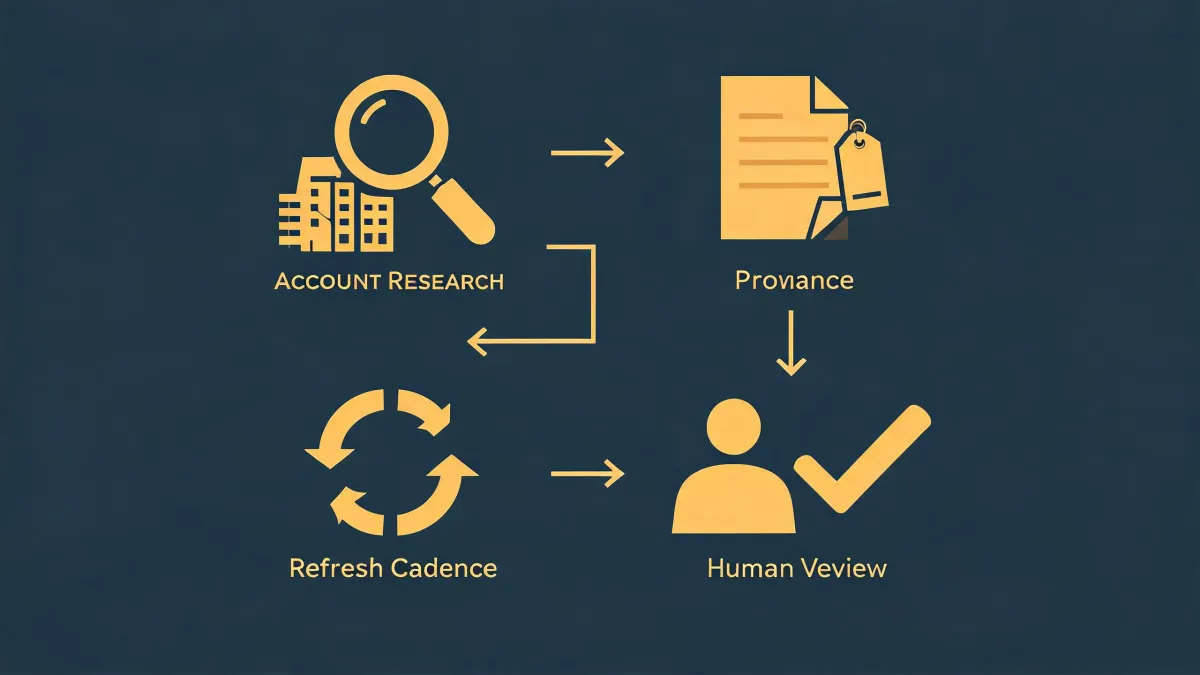
Lead-generation sites should be assessed by the quality of the market signal they provide and the permissions attached to it, because a listing or directory can create a contact without creating a valid outreach premise. Define the buyer decision, preserve source meaning, and calibrate the next action against evidence and negative outcomes.
Define the category before comparing sites
“Lead-generation sites” can mean directories, marketplaces, databases, review platforms, referral networks, publishers, or services that capture inquiries. Define the category and intended job before comparing vendors. A directory helps discover companies; a marketplace may reveal active category participation; an inquiry form can capture an explicit request. Those signals should not share one quality label. Suppose a team is choosing between a broad company directory and a niche marketplace. The directory has wide coverage and useful firmographic fields, but it says little about current intent. The marketplace shows active requests, yet some requests may be stale, incomplete, or posted by intermediaries. Neither site is simply better. For each candidate, record what the site directly shows, when it was observed, what remains inferred, and which independent source could confirm identity or buying role. A record advances because its evidence fits the intended use, not because the site supplied a convenient email address. Use a broad directory and a niche sourcing marketplace as the running procurement case. The directory can reveal manufacturers and firmographic context; the marketplace can reveal posted requirements. Neither automatically proves a current, authorized buyer. Write the intended discovery job, source date, direct observation, permitted inference, verification owner, and rejection rule for each. The comparison begins with evidence type rather than contact count or vendor branding. Run directory versus marketplace once, with labeled sample size and reject reasons. Do not repeat the same pilot under five headings.
I run directory versus marketplace once. Labeled sample: 40 Alibaba RFQ rows from the seller learning-center guidance checked 17 August 2026, and 40 chamber-directory rows. Reject reasons were missing legal name, consumer-quantity asks, and expired contacts. I will not repeat that pilot under five headings. What signal type did the winning source actually carry?
Directories are not intent platforms
Apply the define the category before comparing sites record to this article's running case so this stage changes the disposition instead of restating the framework. Directories are not intent platforms on this lead generation sites page still has to change a disposition: name the owner, the evidence you would keep, and the stop that would close the file. A restated framework without those three objects is not enough for this stage.
Match source type to the discovery job
Map each source to a question: who exists, who fits, who is researching, who requested contact, or who can route a purchase. Select sources whose evidence fits the decision. A large database may support account research without proving intent; a small referral source may preserve stronger context. Do not create a universal “best site” list without a scored use case. Apply one offer and one acceptance rule to both sources. A directory record advances only after an independent company and route check. A marketplace request advances only after its requirement, date, buyer identity, and commercial role become coherent. A licensed provider file must disclose provenance, field meaning, update process, permitted use, and suppression handling. Each source receives credit only for the question its evidence can answer. OKKI Go can be included in the blinded source pilot under the same provenance, verification, correction, and permission rules as every other discovery workflow.
- Lead-generation sites should be assessed by the quality of the market signal they provide and the permissions attached to it, because a listing or directory can create a contact without creating a valid outreach premise.
- Alibaba Seller Central describes RFQ as a marketplace where buyers post sourcing requirements and suppliers select relevant requests and submit quotations.
- “Lead-generation sites” can mean directories, marketplaces, databases, review platforms, referral networks, publishers, or services that capture inquiries.
- Define the category and intended job before comparing vendors.
- For each candidate, record what the site directly shows, when it was observed, what remains inferred, and which independent source could confirm identity or buying role.
Different signals answer different questions
Apply the match source type to the discovery job record to this article's running case so this stage changes the disposition instead of restating the framework. Different signals answer different questions on this lead generation sites page still has to change a disposition: name the owner, the evidence you would keep, and the stop that would close the file. A restated framework without those three objects is not enough for this stage.
Inspect data provenance and permissions
Ask where records come from, how identity and fields are verified, when they were updated, which permissions or notices apply, how objections and corrections propagate, and whether the buyer can delete or export data. Public visibility does not by itself settle fair use or outreach eligibility. Route legal questions to qualified review for the jurisdictions and recipients involved. Blind the source names and inspect ten records from each. Review legal or trading identity, collection source, observation date, field definitions, duplicate history, permission or notice context, correction route, export and deletion terms, and objections. A public page is not a universal outreach basis. Any jurisdiction-specific conclusion goes to qualified review, and a record with missing provenance stays outside the contact queue.
Freshness and rights travel with the record
Apply the inspect data provenance and permissions record to this article's running case so this stage changes the disposition instead of restating the framework. Freshness and rights travel with the record on this lead generation sites page still has to change a disposition: name the owner, the evidence you would keep, and the stop that would close the file. A restated framework without those three objects is not enough for this stage.
Pilot qualification instead of trusting volume
Run a representative pilot including strong fit, edge cases, duplicates, invalid records, and exclusions. Measure verification effort, accepted accounts, correct roles, substantive responses, negative signals, and progression. Separate source quality from message quality and sales follow-up. A vendor-supplied success story is not a substitute for the buyer’s own acceptance test. Run the samples through advance, research, reject, and suppress dispositions. The directory finds a manufacturer that outsources the relevant process, so it is rejected after website verification. The marketplace contains a current-looking request whose specification conflicts with the seller’s capability, so it is also rejected. A smaller marketplace inquiry with a coherent requirement progresses. Record research time and correction burden beside accepted accounts and substantive responses.
Measure accepted evidence
Apply the pilot qualification instead of trusting volume record to this article's running case so this stage changes the disposition instead of restating the framework. Measure accepted evidence on this lead generation sites page still has to change a disposition: name the owner, the evidence you would keep, and the stop that would close the file. A restated framework without those three objects is not enough for this stage.
Set renewal and exit criteria
Set renewal rules for freshness, coverage, correction speed, suppression support, workflow fit, total operating effort, and downstream value. Document who owns derived notes, how access ends, and what must be removed or retained. A source that creates switching risk or hides provenance can be costly even when the contact price appears low. Run the same offer through both sources. The directory may find a plausible manufacturer that fails the route-to-market test after its website is reviewed. The marketplace may reveal an inquiry whose specification conflicts with the sender's capability. Both rejections are useful. They expose different false-positive costs and tell the researcher how to refine the next query. Procurement should therefore test sample records from discovery through disposition, including correction effort and objection handling. OKKI Go can support company research and candidate review, but the team still owns the source interpretation, permission check, and final contact decision. Before purchasing access, take a blinded sample from each site. Can your researcher explain what every field means and when it was observed? Which candidates survive an independent company check? Which apparent buyers are actually intermediaries, students, vendors, or outdated records? How often does a missing role require another source? What happens when a person objects? Does the site preserve enough context to correct the record, or only enough data to contact it? Your procurement note should compare those outcomes, not the size of each database. Run the sample through the same acceptance rule and record both false advances and useful rejections. The winning source is the one whose evidence fits your intended action at a correction cost you understand. At renewal, compare freshness, useful coverage, verification cost, duplicate burden, correction speed, suppression support, accepted progression, and unresolved risk. The winning source is not necessarily the largest; it is the one whose evidence supports the intended action at a known operating cost. The contract should also specify derived-note ownership, export, deletion, access termination, and how objections survive exit. If provenance or correction remains opaque, do not renew.
Keep ownership and deletion practical
Apply the set renewal and exit criteria record to this article's running case so this stage changes the disposition instead of restating the framework. Keep ownership and deletion practical on this lead generation sites page still has to change a disposition: name the owner, the evidence you would keep, and the stop that would close the file. A restated framework without those three objects is not enough for this stage.
Judge a lead-generation site by the record it leaves behind. If provenance and correction are missing, the site is not a source you can defend.
Frequently asked questions
How should a lead-generation site be judged?
By the record it creates: provenance, permission, fit, freshness, and a correction path. A directory of names without those fields is a scrape, not a site you can operate.
What site claim should you verify first?
How the site obtained the record and whether reuse is permitted. A polished UI does not answer that.
When should you stop using a lead site?
When source dates are missing, corrections do not propagate, or the same person appears under conflicting identities.
What should you store from a site-derived record?
The site name, access date, field values as observed, and the reason you kept or discarded the row. That log is the operating asset.

Jane Smith
I’m Jane Smith, a senior content writer with over 15 years of experience in the packaging and printing industry. I specialize in writing about the latest trends, technologies, and best practices in packaging design, sustainability, and printing techniques. My goal is to help businesses understand complex printing processes and design solutions that enhance both product packaging and brand visibility.