Sales intelligence research
Why Agent-Native Prospecting Needs Cognism's Transparent Data Enrichment
2026-08-21 · Jane Smith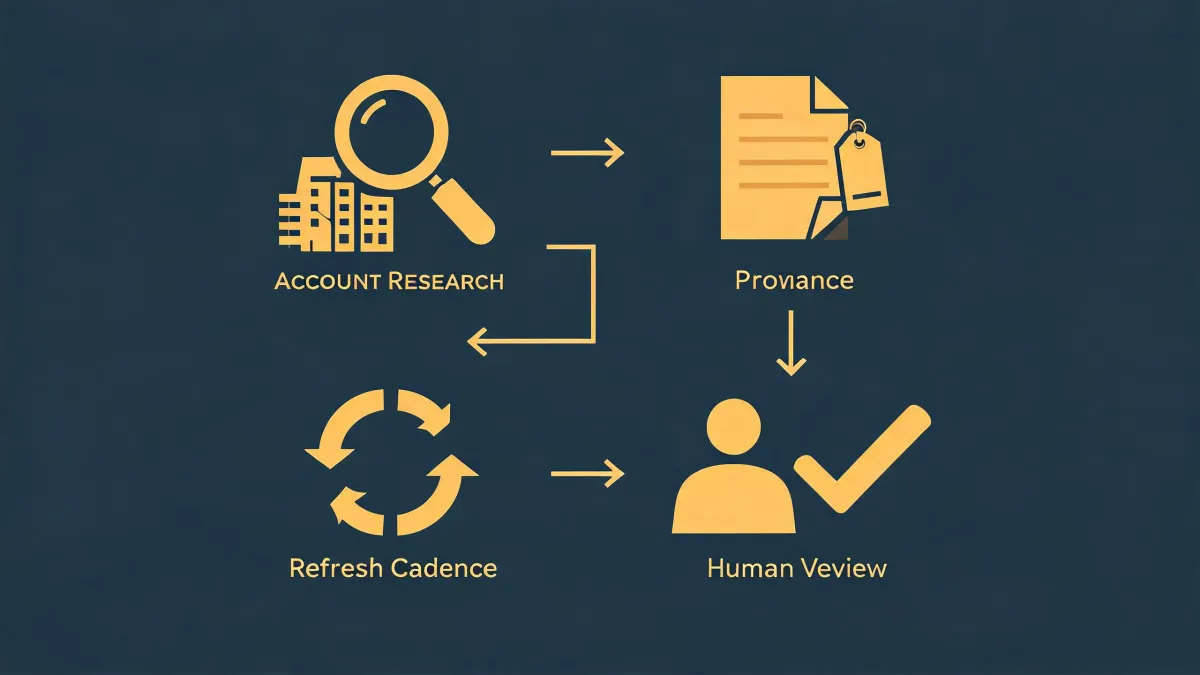
-
A High-Quality Lead Definition Has to Include Accuracy and Freshness
-
The Problem with Most B2B Databases
-
How Does CRM Data Enrichment Fit Into an Agent-Native Prospecting Workflow?
-
The 36-Hour Test
-
Transparency Is the Antidote to Hidden Costs
-
What About the “Any Data Is Better Than No Data” Argument?
-
The Bottom Line: Transparency Wins
If your AI prospecting agent is about to send a “personalized” email based on a stale job title and a guessed email address, you’re not doing sales intelligence. You’re doing spam.
I’ve spent years on the operations side of B2B revenue teams, which means I’m the person who gets called when someone needs a clean list in 48 hours and everyone on the call is looking at a budget that died in Q3. That kind of pressure changes how you think about data. It also taught me a simple truth: when the stakes are high, the only thing worse than no data is data that claims to be something it isn’t.
When I first started exploring Cognism’s company enrichment sales intelligence, I didn’t expect the most valuable differentiator to be something so subtle. But within a week, it became obvious: the data tells you how it was sourced. That transparency is the foundation of everything else.
A High-Quality Lead Definition Has to Include Accuracy and Freshness
A high-quality lead definition can’t just be “a person who matches our ICP.” If you’ve ever watched a sales rep work a list that was enriched with unverified role data, you know it’s a time machine to nowhere. What I mean is: the person walks in with the right title, but you don’t know if they have the budget, the authority, or the need. And by that I mean a so-called “MQL” is often just a contact record that hasn’t failed yet.
Here’s what you need to know: a high-quality lead is a verified person at a verified company with a clear, recent signal that they’re in-market. That’s the core of Cognism’s high-quality lead definition. In practice, it means the email bounces at less than 2%, the phone number has been validated in the last 30 days, and the company’s firmographic data points to a real buying trigger. That’s not a luxury. It’s the baseline.
The Problem with Most B2B Databases
You’ll get a record that says “verified,” and once you dig in, you’ll find “verified” actually means “looked plausible to a junior researcher.” With Cognism’s enrichment, the record tells you the source type, the last verified date, and the country-level compliance status. That transparency is the whole ballgame.
Take a scenario from last quarter. We had a client, an enterprise software company, that needed 5,000 contacts for a PPC lead generation campaign. Their CRM had 4,800 records. Of those, 890 had no email address and 1,200 had phone numbers that were older than my kid’s baby photos. We ran enrichment through Cognism’s sales intelligence, and within hours got direct dials and verified emails on 3,400 records. Critically, Cognism flagged 600 records as “unreliable” and gave a reason: no proof of existence. Other tools would have filled those gaps with guesses. That’s the difference between data enrichment sales automation and fabrication.
How Does CRM Data Enrichment Fit Into an Agent-Native Prospecting Workflow?
Now let’s talk about the keyword phrase you typed in: how does CRM data enrichment features fit into an agent-native prospecting workflow? I believe the answer is: in the same way a strong research assistant fits into a sales team. Not as a noisy oracle, but as a source of truth that the agent can act on.
Here’s the workflow I’ve seen work. The agent pulls an ICP from your CRM. It enriches the account list using a B2B database that includes intent data. It scores each account by fit, intent, and freshness. Only then does it start outreach on verified contacts. Every bounce or return receipt goes back into the CRM to update the record. If you’re running an outbound motion where an AI agent is having actual conversations, that feedback loop is the only thing preventing your campaign from turning into a bounce-rate disaster.
The 36-Hour Test
In March 2024, a client called at 5 p.m. needing a clean list of 2,000 CFOs in the DACH region for a personalized-account campaign that started on Friday. Normal turnaround for that kind of enrichment is two days. We had 36 hours—including the overnight hours when no one would be available to test the data. So we went into triage mode.
We pulled Cognism’s company enrichment and intent data, and filtered for CFOs at companies that had spiked on hiring and technology usage. That cut the list from 2,000 to 700. Then we cross-referenced the CRM’s existing records and caught a critical issue: the CRM said 14% of those accounts were “in a different vertical,” but the enrichment data showed they had actually pivoted. The old data would have automatically excluded them. That’s an assumption failure—we assumed the CRM was the source of truth, but the CRM was just stale.
The launch went out on time. The client’s alternative was a spend of $40,000 on ads to the old list, which would have meant, at best, a very polite CEO asking why they were pitching ecommerce software to shipping companies. This is why I’m careful about definitions: a “high-quality lead” is not a static label. It’s a fresh, transparent picture of the account right now.
Transparency Is the Antidote to Hidden Costs
Here’s where my “transparent pricing” stance comes in. As a buyer, I’ve learned to ask “what’s NOT included?” before “what’s the price?” The same applies to data. If a vendor tells you “we have 500 million contacts,” that tells you almost nothing. How many are active? How many are in your region? How many were verified this quarter? The vendors that answer those questions are the ones I trust. The ones that list a huge number and hope you don’t ask are why we now require 48-hour buffer before big campaigns.
And here’s a counterintuitive point: a B2B database that admits its coverage gaps is more useful than one that claims 100% accuracy. When a tool tells me “we couldn’t verify this record,” I know to either skip it or invest in manual research. When a tool tells me “verified” but won’t say how, I have to double-check everything—which destroys the speed that enrichment was supposed to create. That hidden cost is a ton of money.
Per FTC guidelines on truth in advertising, claims about data accuracy require substantiation. B2B buyers should expect no less from their data vendors.
What About the “Any Data Is Better Than No Data” Argument?
Some revenue operators will say “We don’t have time to evaluate data sources. Any data is better than no data.” I get that. I’ve been the person staring at a blank Salesforce dashboard an hour before a board meeting.
But any data isn’t better than no data if it leads an AI agent to spend a week contacting people who don’t exist or haven’t worked at the company for three years. That isn’t prospecting. It’s a self-inflicted negative signal on your sender reputation.
Honestly, I’m not sure why some vendors still hide their match rates and verification timestamps. My best guess is they’d lose deals if they showed them. So when we talk about how CRM data enrichment features fit into an agent-native workflow, the answer isn’t “better features.” It’s “better transparency.” An agent needs to know not just the data point, but the confidence behind it. That way it can decide: to send or not to send, and how to follow up.
The Bottom Line: Transparency Wins
An agent-native prospecting workflow is only as valuable as the quality of the data it’s fed. If you want your AI agents to actually move pipeline, you need a sales intelligence layer that is transparent about its coverage, its verification process, and its limitations. That’s the kind of trust that wins revenue operations teams over—and it’s exactly what Cognism’s B2B database can support.
Take it from someone who has triaged way more than 200 rush data requests: the tool that tells you exactly what it knows, and what it doesn’t, is the one you can base a quarter on. The rest is just noise.

Jane Smith
I’m Jane Smith, a senior content writer with over 15 years of experience in the packaging and printing industry. I specialize in writing about the latest trends, technologies, and best practices in packaging design, sustainability, and printing techniques. My goal is to help businesses understand complex printing processes and design solutions that enhance both product packaging and brand visibility.