Sales intelligence research
Okki-Go FAQ: Website Intent Data, API Email Verification, and Agent-Native Prospecting
2026-10-09 · Lena Kovacs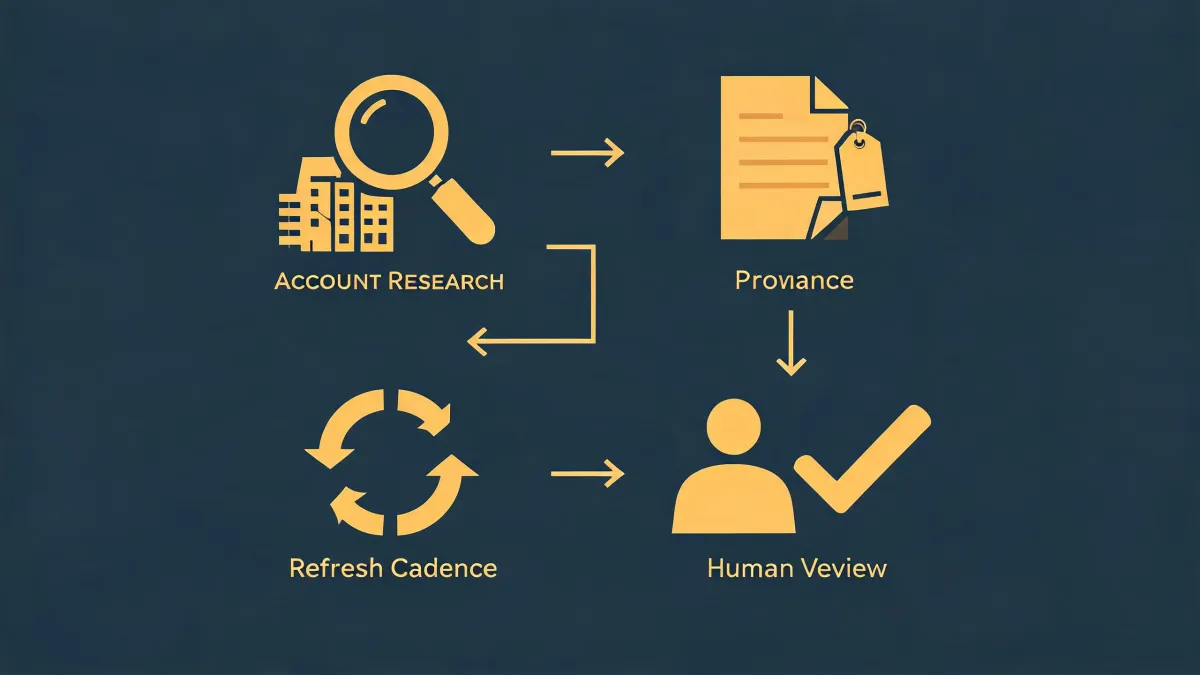
-
1. What is okki-go, plainly?
-
2. What does "agent-native prospecting" actually look like in practice?
-
3. How does website intent data fit into the workflow?
-
4. What exactly does your API email verification check?
-
5. What belongs in okki-go documentation?
-
6. Is buying intent data worth the money?
-
7. When should you look elsewhere?
I run quality at okkigo. Every customer deliverable, every documentation update, every public claim passes through me before it reaches anyone. That habit started with a 2023 audit—our enrichment docs had a claim we couldn't support, which cost us a pilot and earned a checklist I still use today. Roughly one in five first drafts gets sent back for a redo.
This FAQ is what I get asked most on customer calls, in support tickets, and in onboarding threads. Ordered from most frequent to the one I wish more people asked.
1. What is okki-go, plainly?
Okki-Go is an agent-native prospecting platform—it wires prospecting, waterfall enrichment, buying intent signals, API email verification, and human-in-the-loop outreach into one workflow. It's not an email scraper. It's not an autosend cold-email machine. The difference is that an agent handles the mechanical layer (matching domains, running verification passes, ranking by intent signal, drafting the first line), and a human decides the action boundary.
As of Q1 2026, teams mostly use it to stop duct-taping six tools together, not to replace thinking.
2. What does "agent-native prospecting" actually look like in practice?
It means every step is callable by an agent—not just sitting in a dashboard waiting on a click. Identification, enrichment, verification, ranking, drafting: each layer has an API surface that your agent or workflow engine triggers.
The abstraction breaks down like this. In a dashboard-first tool, you might spend a morning exporting CSVs, pasting templates, and manually flagging bounces. In an agent-native tool, you define the logic once—"if intent score is above X and verification status is valid, draft a touch"—and it runs. But. It doesn't auto-send. The draft lands with a human, and the human decides. That distinction matters to me—human-in-the-loop isn't a marketing line, it's a design constraint.
Some teams do fine with manual prospecting. Nothing wrong with that. For most of the teams we work with, though, manual doesn't keep pace.
3. How does website intent data fit into the workflow?
This is where most teams skip a step. The correct order is: identify the domain → judge the intent → enrich the contact → build the audience. Not the reverse.
Website intent data answers the question of who is looking—which anonymous visitors match to known companies. When you feed it into an agent-native system, two things change. First, ranking shifts from "who looks like the ICP" to "who actually showed up and is researching." Second, timing changes. A domain that hit your pricing page yesterday means something different from one that downloaded a whitepaper two months ago and hasn't returned.
I'll be blunt because it's the biggest source of refund requests we see: intent data is an input signal, not a trigger. Someone who bounced off the homepage for four seconds is noise, not buying intent. An agent built around that signal is just producing noise faster.
4. What exactly does your API email verification check?
Our verification layer runs syntax checks, domain and MX record checks, SMTP handshake probes, and known-bounce list matching across sessions. It verifies deliverability, not engagement—those two get conflated constantly.
We don't promise 100% accuracy. Nobody should. Catch-all domains, some portion of catch-all domains, and newly registered domains all carry irreducible noise. What we do is stop the obvious invalids before the send, so your bounce rate stays in a healthy band.
Here's the rookie mistake I made in 2022 when I took over the pipeline—I treated verification as a cleanup step after the fact rather than a gate at the front. Burned through a domain's reputation in the first week. If you're still doing post-send verification, you have the order backwards.
5. What belongs in okki-go documentation?
When I review docs I look for: schema and example payloads for every endpoint—or rather, the whole API surface—rate limits, pagination conventions, error code semantics, and—critically—which operations trigger billing events.
One thing most people forget to demand: data provenance metadata. If okki-go documentation tells you "we provide buying intent data" without saying what the score is derived from, how fresh it is, and what the exclusion criteria look like, that's a document that reads complete and sags in production. Good docs answer why, not just what.
6. Is buying intent data worth the money?
Run the math. If you're paying $3–$5 per lead and adding SDR time on top, an outreach that never converts costs you somewhere between $20 and $40. If intent data lifts your reply rate 15–25%—or closer to 20% for technical verticals—the return isn't a hard sell.
The trap is here. I've watched more than one team treat intent like a contact database. It isn't—it's a prioritization layer. The upside I weigh is the SDR hours you stop wasting on the wrong accounts. The downside is overbuilding around a noise signal and ending up with worse outreach. My rule: if an intent signal can't be mapped to a specific action, it's not worth paying for.
7. When should you look elsewhere?
Saying out loud where we fit earns the trust to be trusted everywhere else. Our strength is multi-touch outbound for email and LinkedIn sequences in mid-market teams. If you're phone-first and need a heavyweight sales engagement platform, Outreach or Salesloft is a better fit. That's not our lane.
If you need a fully-compliant cross-region data partnership with a DPA, your legal team should be in the room, and we won't pretend to make that call for you. If you're at the scale where you should build your own sending infrastructure—build it. A tool that knows its edges is worth giving the core of your workflow.

Lena Kovacs
Lena Kovacs is an independent AI sales agent analyst covering AI SDRs, autonomous prospecting, research agents, email writers, personalization systems, sales assistants, and outbound workflow automation. She applies ISO/IEC 42001 governance concepts while testing task completion, factual accuracy, hallucination rate, approval controls, response latency, personalization relevance, escalation behavior, and auditability. Her evaluations help sales leaders determine where agentic workflows can improve productivity, where human review remains necessary, and how to compare automation claims with measurable outcomes.