Sales intelligence research
What Revenue Operations Teams Should Evaluate in Lead Enrichment (A GTM Engineer's $13,900 Mistake)
2026-10-08 · Sora Nishimura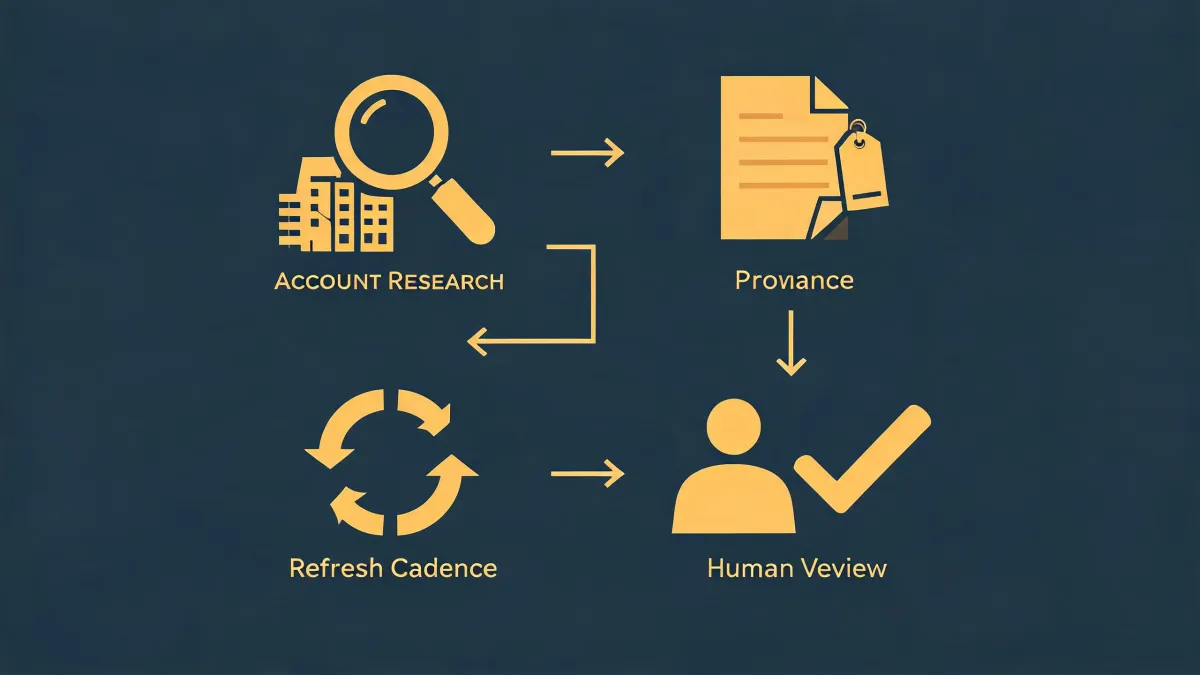
-
Straight answer: evaluate cost per usable record, not cost per record
-
Why I get to talk about this
- Five things worth evaluating, in order
-
The moment the spreadsheet was wrong and my gut was right
-
Where okki-go fits in a realistic workflow
-
When the cheap option is genuinely correct
-
A few boundary conditions
Straight answer: evaluate cost per usable record, not cost per record
The only metric that matters when a revenue operations team evaluates lead enrichment is cost per usable record — match rate on your actual ICP slice, freshness of intent signals, waterfall depth, and the hours your team burns cleaning the output — not the headline price per row. Most teams I've watched compare per-record price, pick the cheaper vendor, and pay three to four times more for it. They just never see the bill on the same invoice.
In Q2 2023 we swapped enrichment vendors on a 120,000-row list, moving from roughly $0.048 per record to about $0.019. Nominal savings: around $3,400 per run. By Q3 I finally sat down and added up the actual cost — $9,100 in SDR hours spent chasing bounces and working bad direct dials, plus maybe $4,800 in RevOps contract hours manually deduping, patching country fields, and re-tagging records that had been sold to us as "verified." Call it $13,900 in waste. The cheap option was four times more expensive, and it took me a full quarter to admit it. A quarter I could have spent building a real process.
Why I get to talk about this
I've been a GTM engineer for about six years — I usually say "since 2019," but the honest answer is late 2018, depending on how you count the contract-to-hire stretch. I've personally scoped, enriched, and wired maybe 600,000 rows of lead data in that time. Probably closer to 500,000, I'd have to check the system.
Along the way I made significant enrichment mistakes I'd estimate cost us somewhere around $40,000 in wasted spend and rework. Possibly more. I'm not going to do the exact math again because I don't want to know. Since Q1 2024 I've maintained a pre-purchase checklist that our team runs before touching any enrichment vendor, and it's caught us roughly 30 near-misses since then — closer to 40, I'm counting from memory. Here's what's actually on it.
Five things worth evaluating, in order
1. Match rate on your ICP slice, not their global number
A vendor will happily show you a 92% global match rate. That number can collapse the moment you filter to, say, US Midwest manufacturing companies between 50 and 200 employees. Before you sign anything, run a pilot on a stratified random sample of your own data — I use 2,000 rows, segmented by industry and region — and check it yourself with a validator you actually trust. Global match rate is marketing. Your slice match rate is the product.
2. Waterfall vs. single-source enrichment
Single-source is cheaper and usually faster, but it fails hard on the same records the waterfall would have caught. I've seen direct dial coverage jump from around 41% to 68% just by moving from a single-source vendor to a properly built waterfall. That delta usually pays for itself in the first week. One warning: a lot of vendors describe "we check two providers" as a waterfall. Ask how many sources, which sources, and how conflicts get resolved. If the answer is vague, it's a marketing term, not an architecture.
3. Fresheness of the intent layer
Two-week-old intent signals and eight-week-old intent signals are different products. Ask when the intent data was last refreshed, not whether intent is "included." A surprising amount of intent data ships on a monthly batch cycle, and teams then treat it like a live trigger and wonder why the reply rates are bad. They're bad because you're emailing someone about a hiring signal they posted in February.
4. Human-in-the-loop quality control
This does not mean the vendor has humans reviewing every row — that wouldn't be economically viable at any price you'd pay. It means: when records break, is there a human on the vendor side who can actually respond, and what's the error rate you should expect? What's the reconciliation window? In 2022 we had a vendor whose bounce rate was sitting above 11% and it took us two weeks to reach a single human being through tickets.
5. Hours your team spends cleaning the output
This is the one everybody skips. Multiply your ops person's hourly rate by weekly cleanup hours, times 52. In our $13,900 disaster, the real discovery wasn't the sticker price — it was this shadow bill. I now force a "cleanup hours per week" column into every comparison spreadsheet and keep it visible during the final call.
The moment the spreadsheet was wrong and my gut was right
During our second evaluation round in 2024, the spreadsheet pointed cleanly at Vendor B. Roughly 18% cheaper, simpler onboarding, and the API docs looked fine at a glance. My gut said something was off. I spent an afternoon reading their error-handling docs and found that failed enrichment records were silently dropped — no dead-letter queue, no webhook, nothing. There's no cell in any spreadsheet that measures that. We went with the pricier vendor.
Even after choosing the more expensive one, I kept second-guessing myself for weeks. What if I was just paying for a logo? What if the cheaper tool's failures weren't actually material? The three weeks until our first production run finished were stressful in a way that was honestly disproportionate to the decision. Then a GTM engineer in a Slack community confirmed it — Vendor B's failed records just vanished. No trace, no alert. That's the kind of detail that never shows up in a comparison matrix, and it's the only kind that matters once you're at scale.
Where okki-go fits in a realistic workflow
I've been evaluating okki-go alongside two other tools for a layered enrichment setup, and the questions I actually care about as a GTM engineer aren't the exciting ones. Not "does it have intent data?" — most do. The real questions are duller: does it play nice with our existing orchestration layer, are the conflict-resolution rules visible, and when a row is wrong can I trace it back to the source that produced it?
Agent-native prospecting is another place where I'd push back on the hype. If a vendor frames a prospecting agent as a button that replaces pipeline work, they're selling a story. In practice an agent handles maybe 60-70% of the repetitive enrichment labor, and the remaining judgment — which signals deserve a human touch — is still you, staring at a spreadsheet at 4pm. That's not a knock on okki-go or anyone else. It's the shape of the problem.
When the cheap option is genuinely correct
There are three situations where going with the cheapest viable vendor is the right call, and I'll defend it:
- You're testing a segment with no historical data. Use the cheapest reliable provider for one run, then decide.
- You're enriching very low-intent leads that only feed an automated nurture sequence. Paying $0.06 more per record makes no sense there.
- You need fallback coverage only, and you already have a process that absorbs a 30% failure rate. Rare, but it exists.
Everywhere else, buying enrichment on per-record price is just relocating cost into SDR performance and RevOps overtime. I've done it. The invoice didn't arrive in dollars — it arrived in trust, which compounds in a currency you can't refund (note to self: stop learning this lesson the hard way).
A few boundary conditions
The pricing benchmarks I'm quoting reflect publicly listed ranges as of Q1 2026, and they will be stale the moment you read this — re-verify current rates before you build a budget around them. Match rates also swing wildly by industry and region, so if a vendor's number is dramatically better than what you're seeing in your own pilot, treat it as a ceiling, not a forecast. And the $13,900 figure is my specific math on my specific list. Yours will look different. The category of the mistake won't.

Sora Nishimura
Sora Nishimura is an independent cold-email deliverability analyst covering email warmup, inbox placement, sending domains, mailbox rotation, spam testing, and outbound campaign infrastructure. She relates ISO/IEC 27001 controls to credential handling while measuring hard-bounce rate, complaint rate, placement by provider, domain reputation, authentication alignment, daily volume, and recovery time. Her practical guides help growth teams configure safer sending systems, diagnose delivery failures, and scale cold outreach without confusing volume with genuine reach.