Sales intelligence research
Okki-Go Prospecting Examples: Email Finder, Human-in-the-Loop Review, and B2B Database Guide
2026-09-08 · Jane Smith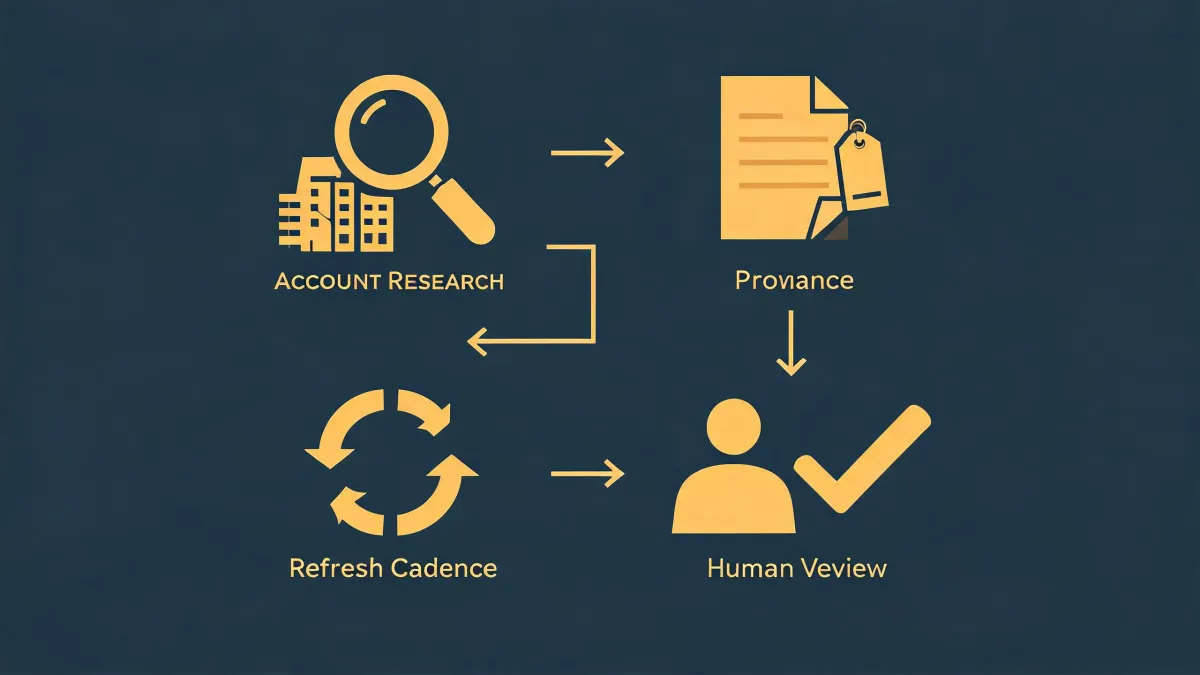
-
What exactly is Okkigo?
-
What do okki-go prospecting examples look like after a quality review?
-
How accurate is the okki-go email finder?
-
What does human-in-the-loop review mean in an outbound workflow?
-
What is sales email, and when should a B2B sales team use it?
-
How should buyers evaluate a B2B database without falling for low-price bait?
I'm the quality/compliance manager at Okkigo. My job is to review prospect lists and outbound workflows before they're marked campaign-ready. In an average quarter, that means 200+ unique lists. In Q1 2026, I rejected roughly one in ten first versions—usually because a B2B database record was stale, a source wasn't transparent, or a suppression rule wasn't applied.
This FAQ is the review I'd hand someone asking about okki-go prospecting examples, the okki-go email finder, our human-in-the-loop review, and what is sales email and when should a B2B sales team use it. One caveat: this reflects what I saw as of Q1 2026. Data quality changes fast, so verify current examples with your own sample.
What exactly is Okkigo?
Okkigo is an AI sales prospecting platform. It's not only a B2B database or only an email finder. The platform combines account selection, contact discovery, enrichment, email verification, intent data, and outreach under one workflow.
The phrase agent-native prospecting is what separates it from a static directory. Instead of asking you to assemble every step manually, Okkigo can start with a target account list, identify buyers who fit the role, look for current email addresses, enrich the gaps through several sources in a waterfall, and flag accounts with relevant intent.
I still don't describe it as replacing a sales team. The reason human-in-the-loop exists in our product is because the data and the AI can both be wrong. A quality checkpoint is part of the workflow, not a warning label.
What do okki-go prospecting examples look like after a quality review?
My favorite okki-go prospecting examples have one thing in common: a reason to contact, not just a list. A typical example we approve starts with a set of accounts that match the buyer's ICP and have shown relevant intent.
Here's how it usually plays out. A RevOps team gives Okkigo 300 accounts from the B2B database that recently looked at content about, say, lead response time. The platform finds sales leaders at those accounts, and the okki-go email finder fills in work emails using domain patterns. Then the enrichment waterfall checks alternative sources and removes poor matches. Before the sales email is scheduled, I can see who's going to receive what and why.
Another pattern I like is a job-change trigger. When a buyer moves to a new company, their new email is often not in the same source. Okkigo searches for the new role and runs verification before adding them to an outbound sequence.
How accurate is the okki-go email finder?
I'll answer the same way I answer internal review questions: accurate enough to be useful, not accurate enough to skip verification. Okkigo doesn't claim 100% accuracy on our own email finder, and I'd be suspicious of anyone who does.
The finder checks formatting, domain records, and common catch-all behavior. But that's not the same as knowing whether a reply will land in a busy inbox and get a response. Catch-all domains can accept almost any address and still hide a dead inbox. That's why I separate found from verified enough to try.
One time-bound note: accuracy varies by industry and data source. What looks good in software may look worse in manufacturing. Run your own test.
What does human-in-the-loop review mean in an outbound workflow?
Human-in-the-loop review means there is a checkpoint before a campaign goes live. For Okkigo, that typically means reviewing the audience, the reason code, and the final outreach copy before automation takes over. It doesn't mean every single email gets proofread by a person. It means a person is accountable for decisions that a model shouldn't make alone.
I didn't always believe this was necessary. I remember signing off on an export without rechecking the suppression list because we were behind schedule. We found the problem only after a salesperson asked why one company had received four identical emails. The cleanup was more painful than the human checkpoint would have been. That's how I learned to treat human review as an efficiency tool, not a bottleneck.
What is sales email, and when should a B2B sales team use it?
A sales email is a targeted, asynchronous message sent to a specific buyer because you have a business reason to believe they might care. It isn't a newsletter, and it isn't a blast to 10,000 contacts. It should be specific enough that the recipient understands why they received it.
A B2B sales team should use sales email when:
- You know the account and the person you need to reach.
- A trigger or research finding gives you a reason to write.
- You have reliable contact data from a B2B database or an email finder.
- You can offer a clear, low-friction next step.
- You have a process for replies, bounces, and opt-outs.
When is it the wrong choice? When you have no reason, no verified address, and no follow-up plan. At that point, another sales channel won't fix the underlying problem.
How should buyers evaluate a B2B database without falling for low-price bait?
I've said this in internal reviews for years: price comparison should come after quality comparison, not before. The cheapest B2B database can become expensive after bounced emails, returned messages, duplicate records, and time spent cleaning the list. The highest-priced one can also be wrong. The goal is total cost per viable conversation.
When I evaluate a database, I run a small sample and ask for source transparency. Where did this record come from? How often is it refreshed? Does one source cover a specific industry better than another? Okkigo uses a waterfall approach because no single B2B database has complete, current coverage. It enriches from multiple sources and keeps the best result, then human review catches what automation cannot.
A vendor who can't explain those steps is a reason to slow down. If you test Okkigo, do the same thing: send a sample through your CRM, check duplicates, listen for negative replies, and verify whether the okki-go email finder improves over your current process. The answer will depend on your ICP, not just on a dashboard.

Jane Smith
I’m Jane Smith, a senior content writer with over 15 years of experience in the packaging and printing industry. I specialize in writing about the latest trends, technologies, and best practices in packaging design, sustainability, and printing techniques. My goal is to help businesses understand complex printing processes and design solutions that enhance both product packaging and brand visibility.